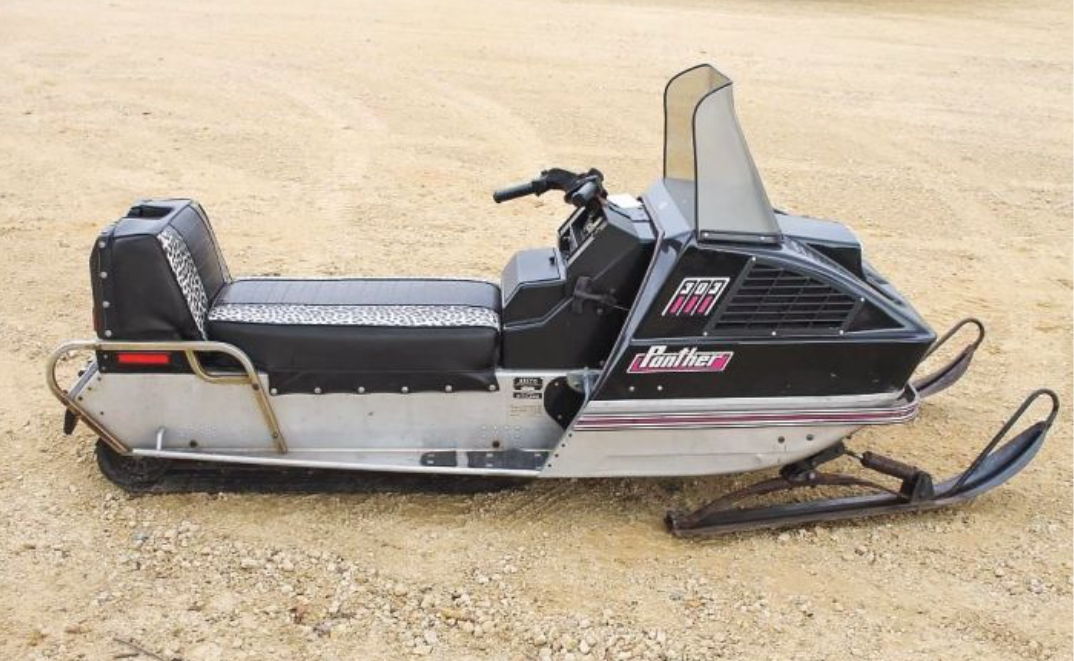
Arctic Cat sold almost 32,000 sleds with Wankel rotary engines between 1968 and 1975, several times more than all the rest of the snowmobile industry combined. And with about 10,000 units, the 1972 Panther 303W was Cat’s most popular rotary sled.
But by 1977, the revolutionary rotary engines had vanished from all snowmobile brands. What killed this engine of the future?
This article originally appeared in the November 2025 issue of Snow Goer magazine. That means you could have enjoyed it long ago if you only subscribed! Go ahead and sign up today to get the print or digital edition of the magazine and feed your love of the greatest winter sport ever created.
The Back Story
Perfected in the late 1950s by Dr. Felix Wankel of West Germany’s NSU Motorenwerke and licensed for development to others (including Germany’s Fichtel & Sachs), the rotary engine is very simple. A three-sided rotor spins inside a trochoid (two overlapping circles, like the Master Card logo) combustion chamber to open the intake port, compress the air-fuel mixture and expel the burned charge.
Compact with few moving parts that virtually eliminated vibration, easy to pull over and non-critical of fuel, rotary engines initially produced more horsepower for the weight and displacement with much greater low-end torque than the heavier industrial two-strokes then used in snowmobiles.
Beginning in the late 1960s, 11 brands built at least one sled with 303cc Sachs KM-914 Wankel power. But Sachs supplied them in quantity to only three brands – Arctic Cat, Skiroule and Alouette. Meanwhile, Outboard Marine Corporation (OMC) developed its own larger and more powerful American-made Wankel for its heavier, more expensive Evinrude and Johnson brand sleds.
The Rise
Arctic Cat introduced the Wankel Panther in 1968 without even putting the model in the sales brochure. The brand sold more than 2,000 Panther rotaries in model year 1969 despite pricing them above almost all other Panther models. And in 1971, Cat’s 1,600 Wankel Lynx were in such demand that they often retailed for above list price. They added to 4,000-plus ’71 Wankel Panthers for the most successful year yet for rotary engine sleds.
Cat’s total rotary sled production increased again for 1972 when the P-303W set the single-season sales record for Wankel sleds despite being priced the same as a 399 two-cylinder Panther that had about 50 percent more horsepower.
It was easy to see why Wankels were so popular. Not only was the Wankel sexy new technology, but the smooth-running rotaries would cruise gracefully for all-day family rides.
Plus, the Wankel sleds would go just about anywhere – though they wouldn’t get you there quickly, with a top-end speed that struggled to reach 50 MPH at best. The hill climbing and deep snow capability of these Panthers were generally unmatched, as I learned from “Cattin’ Around” on my buddy Gil’s 1971 P-303W and a 1972 demo unit with the same engine.
Low noise emission was another Wankel attraction. Arguably quieter than two-stroke sleds, their “thump-thump-thump” exhaust tones lacked the high pitched “ring-ding-ding” two-stroke noise components that annoyed some people.
Unfortunately, Cat’s unique P-303W mufflers rusted out quickly, making the sleds much louder as they aged.
The Demise
Sachs introduced its new 295cc KM-24 rotary that produced 23 HP for 1973. Arctic’s discontinuation of the Panther 292 one-lunger left the new 295 Wankel as the low end of the big two-up Cats, and illustrates a big reason why Wankel sales started to slip.
When the KM-914 Wankel was introduced in the late 60s, 20 horsepower from a single-cylinder two-stroke engine was mainstream sled technology, and the rotary was clearly a better, if more expensive, alternative. However, the snowmobile performance wars of the ’70s hastened the rise of high-performance two-cylinder engines, and 20 horses quickly became entry-level sled power. But Wankels still required premium pricing.
To try to stay competitive, Sachs created a 35-HP 606cc two-rotor Wankel, but cooling troubles in Arctic’s field testing killed it quickly.
The 1973 Arab oil embargo whacked sales of all gas-powered vehicles in general, and created a focus on fuel economy which was not a Wankel strong point. Plus, Wankels were sometimes reluctant to start, were intolerant of starting ether, ran very hot, were really finicky about oil and seemed to wear out more quickly. So interest in rotaries began to crater.
Cat’s Sachs Wankel-powered lawn mower also flopped badly, but that’s a story for another time.
Nevertheless, Arctic still sold 3,000 Wankel Lynx and 2,200 Wankel Panthers for 1974. The last stand was 1,500 1975 Wankel Cheetahs.
My ride on my buddy Pat’s Cheetah rotary was an enjoyable experience, but a fairly leisurely one compared to my 55-HP 1974 El Tigré. Still, the Wankel Cheetah would power through deep snow where my Tiger was generally helpless.
By 1975, the Alouette and Skiroule brands were all but dead. OMC pushed its Wankel up to 45 HP but they were not very competitive products and the company quit the sled business in 1976.
Wankel sleds had their decade in the sun, especially for Arctic Cat, before disappearing. Today, you should check out any of these interesting machines when you get the chance.