Trail riding doesn’t just happen—it’s built, maintained, and protected by a network of volunteers most riders will never meet. And for the past two decades, Polaris Inc. has quietly been helping fund that work.
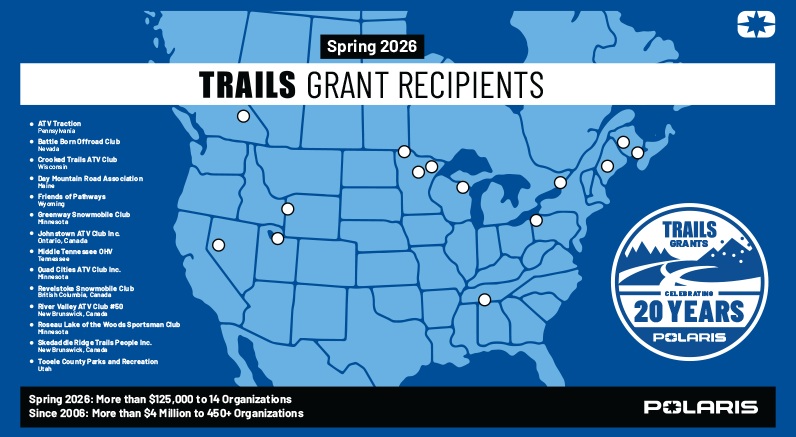
This spring, Polaris announced its latest round of TRAILS GRANTS, awarding more than $125,000 to 14 off-road ATV and snowmobile organizations across the U.S. and Canada. The milestone is a significant one: 2026 marks the program’s 20th year.
Small Grants, Big Impact
Each selected club or organization can receive up to $10,000, with funding going toward projects that directly improve riding access and safety—everything from trail maintenance and bridge repairs to signage, trailheads, and youth education programs.
That might not sound like a massive number in the context of powersports, but at the local level, it’s often the difference between a trail staying open or falling into disrepair.
Projects funded this year include bridge replacements and safer trail crossings, trail restoration to address erosion, new signage and navigation improvements, and youth safety training initiatives.
The Backbone of Riding: Local Clubs
The TRAILS GRANTS program was launched in 2006 specifically to support grassroots riding organizations—clubs and associations that handle the day-to-day reality of trail systems.
Since its inception, the program has contributed nearly $4 million and supported hundreds of organizations across North America.
What makes the program notable isn’t just the dollar amount—it’s what it represents. While OEMs build the machines, the riding experience itself depends heavily on community infrastructure.
Polaris Inc. positions the initiative around three core ideas: preserving access, promoting responsible riding, and supporting environmental stewardship.
That aligns with a broader reality in powersports: access is fragile. Trails can disappear due to land use conflicts, lack of maintenance, or safety concerns. Programs like this aim to keep those systems viable long-term.
As Polaris CEO Mike Speetzen put it, the program is ultimately about supporting the people “doing the hands-on work.”
Why It Matters
For riders, it’s easy to take a well-marked, groomed trail for granted. But those trails are the result of constant effort—often volunteer-driven, frequently underfunded, and always at risk of neglect. Behind every smooth corner and clearly marked junction is a local club putting in hours most riders will never see.
Programs like TRAILS GRANTS don’t solve everything, but they do something arguably more important: they reinforce the idea that access is a shared responsibility between manufacturers, clubs, and riders. Twenty years in, that support has become part of the infrastructure of the sport itself.
That said, looking at this year’s recipients, many of the selected organizations lean toward ATV-focused clubs. While that reflects the broader off-road landscape, it would have been great to see more snowmobile clubs represented in the mix—especially considering how critical organized clubs are to building and maintaining winter trail systems.
Hopefully that balance shifts in future rounds. If your local snowmobile club could use a boost—whether for grooming equipment, bridge work, signage, or safety programs—it’s worth throwing your hat in the ring next year. These grants can make a meaningful difference, and the more snowmobile voices in the applicant pool, the better the chances of stronger representation moving forward.
Below is a list of the clubs selected for the 2026 program:
Tooele County Parks and Recreation (Utah) – Upgrade signage along the Jacob City multi‑purpose off-highway vehicle (OHV) trail system to improve navigation, safety awareness, and trail sustainability.
ATV Traction (Pennsylvania) – Expand hands-on youth ATV safety training by acquiring youth-sized ATVs and additional safety equipment to support responsible riding education.
Battle Born Offroad Club (Nevada) – Maintain and adopt popular OHV trails focusing on trail maintenance, signage repair, and litter removal.
Crooked Trails ATV Club (Wisconsin) – Install a new signage system throughout the trail network to highlight safety areas, improve navigation, and support future trail growth.
Day Mountain Road Association (Maine) – Restore the multi-use Lions Trail to address erosion, protect nearby aquatic habitat, and maintain safe access for ATV, snowmobile, and non-motorized users.
Friends of Pathways (Wyoming) – Replace a failing bridge on the Cache Creek Trail near downtown Jackson, improving year-round multi-use access and meeting universal trail design standards.
Greenway Snowmobile Club (Minnesota) – Support the Warba Bridge Recreational Crossing by incorporating a dedicated trail corridor into a planned highway bridge reconstruction, creating a safer, year-round multi-use trail connection.
Johnstown ATV Club Inc. (Ontario, Canada) – Restore and extend a critical trail segment to improve connectivity, reduce road riding, and address long‑standing flooding and erosion issues.
Middle Tennessee OHV (Tennessee) – Launch a youth all-terrain vehicle (ATV) safety and responsible riding training initiative providing firsthand education, protective gear, and trail etiquette instruction for young riders.
Quad Cities ATV Club Inc. (Minnesota) – Develop safer, more sustainable trail access by building a designated trailhead parking area and maintaining surrounding trails to improve flow, address erosion, and remove hazards.
Revelstoke Snowmobile Club (British Columbia, Canada) – Improve waste management and reduce garbage in high‑use backcountry riding areas through new trailhead infrastructure and a community‑led alpine clean‑up that promotes long‑term stewardship.
River Valley ATV Club #50 (New Brunswick, Canada) – Expand trails to better connect riders to fuel, food, and lodging, improving destination access and supporting local tourism.
Roseau Lake of the Woods Sportsman Club (Minnesota) – Reconstruct bridges on Butler Grade to maintain a critical trail connection between William and Roosevelt, Minnesota, improving safety and long-term trail access.
Skedaddle Ridge Trails People Inc. (New Brunswick, Canada) – Repair the Big Teague Brook bridge to restore a safe ATV crossing and reduce environmental impacts from off‑trail detours.