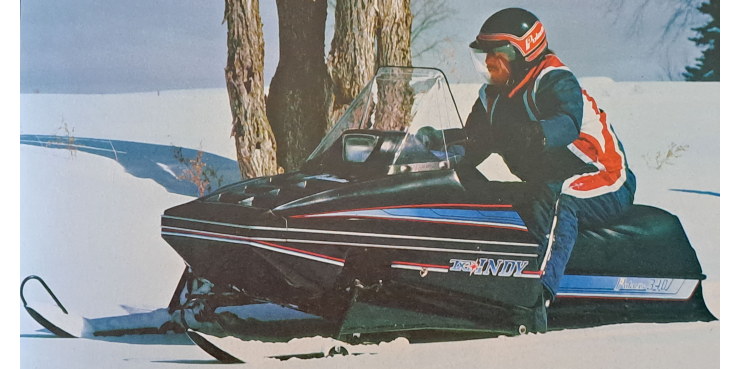
1980 Polaris TX-L Indy: The Sled That Saved Polaris
More than a dozen snowmobile brands and component suppliers built some type of a coil-spring-over-shock ski suspension during the 1970s, mostly for race sleds that were not trail legal or even available to the general public. Only Hellstar’s little-known 1970-71 Jet Star and Arctic Cat’s 1979-81 Trail Cats were offered to trail riders, but neither was successful.
Then the 1980 season saw the long-awaited arrival of a sled that signaled the beginning of the end for leaf spring ski suspensions: the Polaris TX-L Indy.
First and foremost a cross-country race sled, the initial Indy evolved into a series of sleds that reversed dwindling sales for the then-fading brand, ensured its continued existence and led it to a dominating position in snowmobiling marketshare for a couple of decades.
Birth Of A Legend
The advantages of the coil-over-shock ski suspension were substantial. Longer travel than leaf springs allowed greater speed with better handling and improved ride quality on bumpy trails.
But there was also more weight, complex new problems like bump steer and added cost. These factors had derailed earlier attempts by some other brands, including Chaparral and Scorpion.
In 1976, the Villeneuve brothers Skiroule team finally drove home the advantages of the coil-over concept to the rest of the industry.
Using a sprint car-derived ski suspension with two parallel radius rods and a leading arm (commonly and arguably incorrectly referred to as a trailing arm by many snowmobilers), they humiliated all the big factory teams on a bumpy snow track on a memorable weekend in New Hampshire.
Polaris adopted this ski suspension concept for its 1977 RXL oval racers and immediately dominated factory oval sprint racing. With that success, the Roseau crew decided to take this superior suspension concept to terrain racing.
Work on what would become the TX-L Indy began in the spring of 1978. The goal was doubling the 3 inches of travel offered by conventional leaf spring ski suspensions to accompany the new Polaris longer-travel skid frame while retaining as many existing TX parts as possible.
All development work was trial-and-error because computer-aided design (CAD) didn’t exist yet.
What emerged was similar to the RXL front end but with more rugged construction, more travel with minimal bump steer, and new bridgework skis. Also, a new rear arm on the skid frame allowed it to provide a full 6-inches of travel to match the front end, a very impressive number for the day.
Power came from Polaris’ year-old 340 Fuji “water burner” that had been developed for International Cross Country Snowmobile Federation (ICCSF) competition with its 56-horsepower limit.
One interesting departure from conventional practice was locating the heat exchangers under the footrests rather than up inside of the tunnel. The theory was that they would help keep the rider’s feet warm when in that location.
On December 10, 1978, Polaris rolled out two Indy test mules at the Lake Vermillion, Minnesota, cross-country race and ran first and second in the prototype class. Continued field testing brought multiple proto-class wins and culminated with corporate approval to put the sled into production for the 1980 model year.
Enough were built to qualify the sled for ICCSF stock-class competition, where they did exceptionally well.
Even better, Bruce Olson rode a 1980 TX-L Indy to a win in the Winnipeg to St. Paul International 500, the premier cross-country event of the day. In fact, Polaris racers took eight of the top 10 finishing positions.
By the following season, the Indy had become a consistent winner in terrain racing and consumer demand for the sled was beginning to grow.
Turmoil and Triumph
The late 1970s and early 1980s were very challenging times in the then-shrinking snowmobile industry.
Lighter winters, much higher gas prices and a severe economic recession strangled consumer demand for sleds. All of the remaining sled brands were again looking at big piles of unsold inventory and oceans of red ink on their accounting ledgers.
Despite continued racing success, Polaris had dwindling sales and marketshare, so its owner Textron put the Polaris division up for sale. In October of 1980, Bombardier announced it would purchase Polaris, but the U.S. Justice Department blocked the sale due to anti-trust concerns.
As a last resort, Textron sold the sled business to its division managers in July of 1981, and the current version of Polaris Industries was born.
The new company pinned much of its hopes on the excellent new Cutlass leaf spring sleds with lower price points. However, development on the Indy continued, beginning with the Indy Centurion 500 triple in 1981.
Subsequently the Indy line saw annual improvements and new model proliferation.
Demand for the Indy series rocketed upward, far eclipsing demand for the Cutlass series, and pushed Polaris to first place in sled sales by the late 1980s while several other remaining competitors were forced out of the snowmobile business, including Arctic Cat, Scorpion, Kawasaki, John Deere, and Bombardier’s Moto-Ski. Arctic Cat, of course, would later return.
In short, the Indy saved Polaris. It also modernized the sport by permanently changing riders expectations.
The TX-L Indy 340 remained mostly unchanged through 1984, then was replaced in 1985 by a new and more trail friendly Indy 400. But we will save that story for another day.
SPECS
Manufacturer: Polaris Division of Textron Inc., Minneapolis, Minnesota, at Roseau, Minnesota
POWERTRAIN
Engine: 333cc Fuji Heavy Industries Polaris Superstar ECPL34-05 liquid-cooled mono-block piston-port twin with two Mikuni VM-38 slide valve carbs and silencing air box, capacitor discharge ignition (CDI), and single tuned pipe into Polaratone muffler
Lubrication: Pre-mix at 40:1
Power output: 56 horsepower
Electrical output: 90 Watts
Clutches: Polaris Automatic Torque Balanced drive and driven
Chassis Type: Painted aluminum with Ren-flex belly pan, tube steel rear bumper, fiberglass hood, and non-vented plastic nose cone
Claimed weight: 425 pounds dry, 474 pounds wet
Front suspension: Leading arm with dual radius rods, coil springs over hydraulic shock absorbers, and sway bar
Ski stance: 36.5 inches
Rear suspension: Aluminum slide rails with one coil spring over a hydraulic shock absorber on the front arm, and torsion springs with one hydraulic shock on the rear arm
Track: Yokohama 15- by 121-inch molded rubber with dual sprocket internal drive
Brake: Hydraulic disc
Fuel capacity: 7 gallons
Standard equipment: Speedometer/odometer, tachometer, engine temp warning light, Kelch gas gauge, kill switch, handlebar pad, rear seat storage compartment, dual tail lights, snowflap
MSRP: $3,149