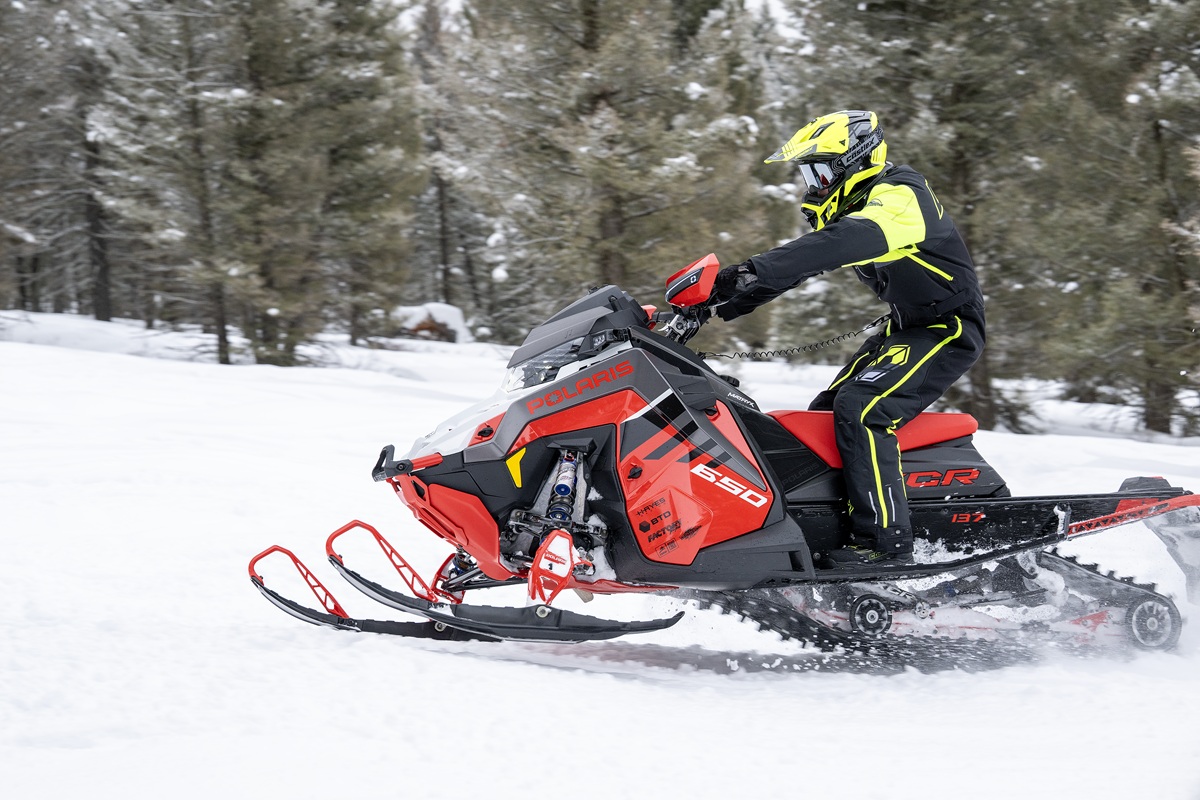
Some folks who glance at the specs of the 2025 and 2026 Polaris Indy XCRs may think this is a year of minor changes and bold new graphics for the brand’s most hard-charging short-tracked machines.
Those riders, though, are completely missing the boat!
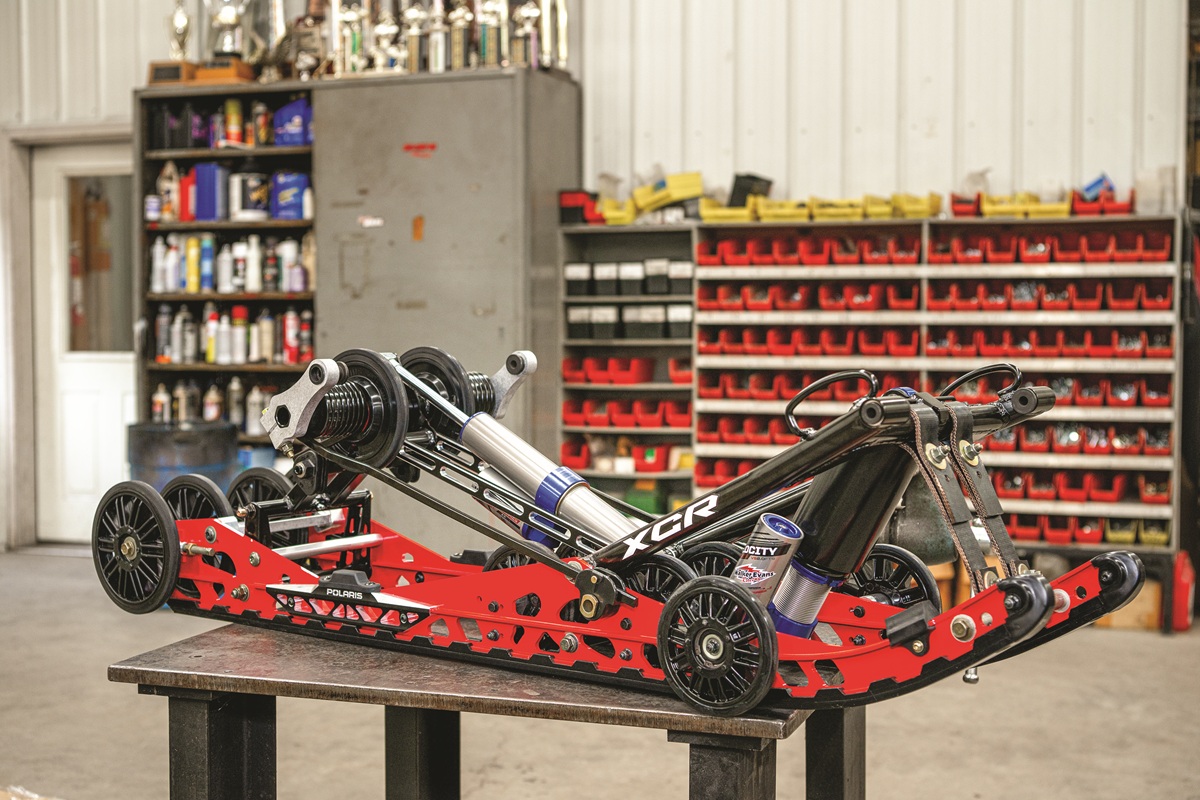
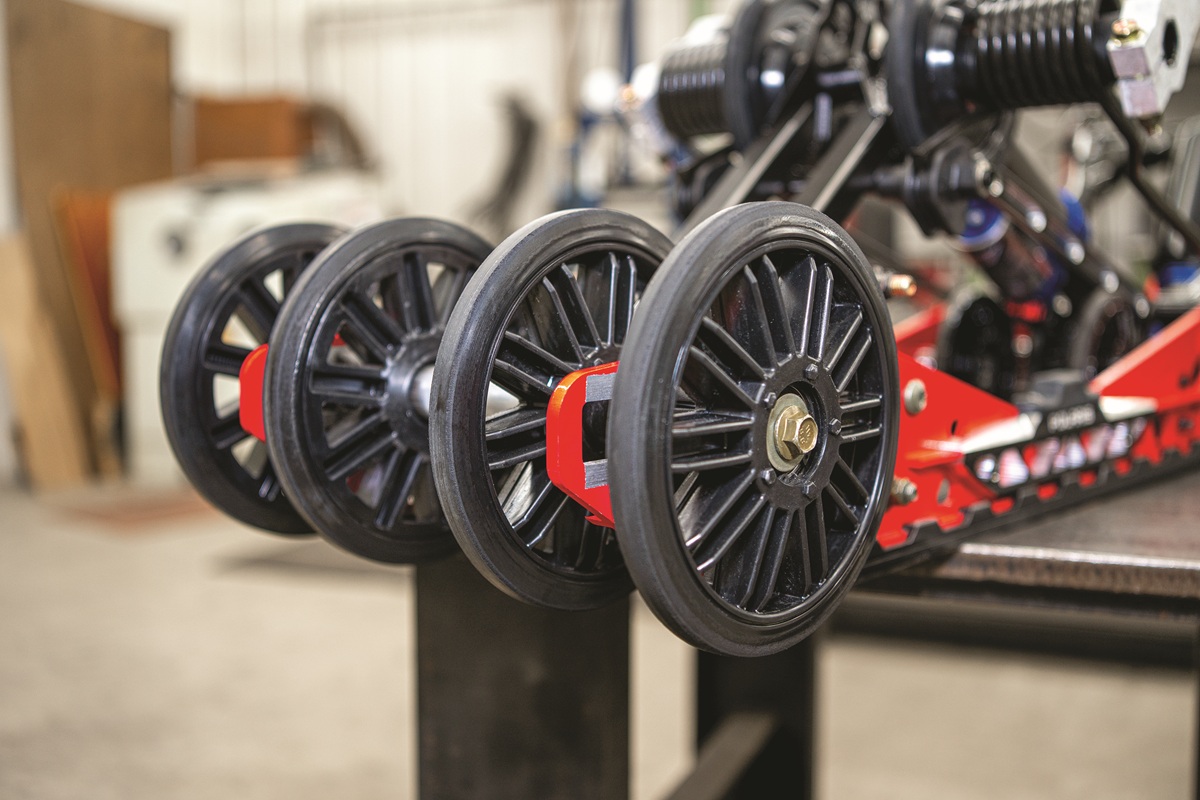
While the 2026 spec chart might still say “Rear Suspension: Pro-CC,” that skid frame has been completely rethought. So-called “Long-Tail” geometry has been integrated onto the XCR’s version of the Pro-CC. Plus, more firm suspension calibrations all around the vehicle have significantly upgraded the sled’s already assertive personality.
Our test team concurred with Polaris’ claims when we found the 2026 pre-production XCRs were much less prone to bottoming when charging through ungroomed mogul fields, yet also more reactive and fun in all conditions.
It starts with new rear torsion springs that have much longer “tails” that mount much farther forward on the rail. That, designers say, changes the way the suspension arms work together. How can such a seemingly small geometry change plus spring rate alterations make such a huge impact? We turned to Senior Staff Engineer Matt Prusak and Snowmobile Marketing Manager Nels Eide looking for answers.
(For the record, Matt Prusak is in no way related to the editor of this magazine with the same surname.)
This article originally appeared in the October 2025 issue of Snow Goer magazine. That means you could have enjoyed it long ago if you only subscribed! Go ahead and sign up today to get the print or digital edition of the magazine and feed your love of the greatest winter sport ever created.
SG: Where did the project that became the new Long-Tail rear suspension geometry begin?
NELS EIDE: “From the customer side, we monitor a lot more data and customer insights than I think normal people think. Specifically on our high-performance sleds, we’re always making sure that we’ve got them in the right spot to deliver the performance that the customer expects. Nobody just happens to walk in and accidentally buys a 9R Indy XCR – it’s a snowmobile they’re seeking.
“So, we watched the customer evolution closely as we brought on the VR1 [with Walker Evans Velocity shocks] and then VR1 with Dynamix. They cover any kind of groomed trail conditions that a rider can find. We became pretty confident when we put all of that together that there was room to take the XCR up in aggressiveness. The [XCR] customers were looking for more and were sometimes going to the aftermarket to get more. Because the offerings we had on the rest of the trail sleds were so dang good, we felt confident we could give that XCR customer more.”
MATT PRUSAK: “We started working on [the suspension changes] pretty early. We had a dedicated cross-country race vehicle starting in model year 2022 – our 600 Indy Cross Country – which gave us an opportunity to just focus on the cross-country venue and make suspension technology better. Because, as a sled’s suspension works better, we collect more trophies. That’s a good thing for our race department, but it’s also a good thing for our customers.
“Through 2022 and 2023, that vehicle had a ton of success. But what’s unique about the Cross Country is it also gives us a venue to develop new suspension technology on a small scale. We only build a small number of those units per year, so it’s a great opportunity to flesh out innovative technology.
“When I talk about some of the technology that’s in the 2026 Indy XCR – like the Long-Tail rear suspension [geometry] – we rode some of those concepts many years ago as we were developing a better Indy Cross Country race sled. A lot of that launched on the model year ’24 [Cross Country] and has been really good for us in the race venue, and it has now made its way to the customer’s hands for ’26.
SG: What were your racers seeking that the previous rear suspension didn’t offer? And when did you start envisioning a consumer sled application?
MATT PRUSAK: “Racing is real simple: It’s about lap times and going faster. So, two key areas that we were looking to improve was G-out bottoming resistance and on-throttle steering. As you make those aspects better, you can corner more aggressively and you can attack whoops faster. You can actually set up the suspension to be more compliant without bottoming.
“Initially it was just for racing, but after riding some of the first concepts, it absolutely highlighted that there was an opportunity on the consumer side as well. Our Cross Country race sled and our XCR are very similar – they share nearly all of the same content minus the very race-specific parts that are needed for the Cross Country only. So, as we made the Cross Country race sled better, absolutely we thought there’s a place for this in the consumer world.”
SG: Jumping into the changes, most consumers can understand going stiffer with the spring and shock settings, but how and why did your team decide to dramatically change the torsion spring geometry?
MATT PRUSAK: “It was largely developed with computer simulation. We use advanced Multi-Body Dynamics (MBD) tools to model the performance of all of our snowmobiles. And through predictive analysis, we landed on an opportunity to target a more aggressive rear torque arm with a progressive spring rate. That was all developed in simulation.
“Obviously the key with any simulation is that it’s correlated to the real world – we have to put on a helmet and ride it. So we built prototype components and had a test session at Alex Hetteen’s race shop to validate that the simulation wasn’t lying to us, that our assumptions were proper, etc. After the first ride, I mean honestly, the first trip through a set of whoops for me, it was pretty obvious that we’d made a big improvement.”
SG: From an engineering perspective, what are you physically doing by extending the torsion spring 8 inches forward and changing its front mounting point?
MATT PRUSAK: “At a high level, a rear suspension kind of has a front half and a rear half. And through years of suspension development by multiple industry players, the challenge or the magic is getting the two to work well together. You need two halves so that you can articulate over bumps, and getting them to work well together is really important.
“Moving the spring perch farther forward and moving toward a Long- Tail architecture essentially accomplishes that. You get improved load-sharing from the front torque arm to the rear, and from the rear torque arm to the front. And it’s not through traditional means of mechanical coupling.
“Mechanical coupling has kind of a harsh, abrupt transition that can be felt. At times it can be undesirable to over-couple as I’m sure you’ve felt when riding. So, the big improvement is how the front arm and the rear arm of the rear suspension carry and share the load better. As the front arm approaches a bump, it shares load from the rear; as the rear end takes a hit, it borrows from the front, etc. That’s the first big benefit.
“The second big benefit is it changes the motion ratio of the spring. If you remember back to the Rush days, we had a shock and a coil spring mounted in the same unit, where the motion ratio of the two were the same. With a more conventional torsion spring suspension, like we’ve had since Pro-CC was unveiled in model year 2019 where the torsion spring and the shock are separate, the motion ratios are separate so you can tune them independently.
“The Long-Tail architecture allows for a more progressive spring rate of the torsion spring, which helps a bunch of things: bottoming resistance and on-throttle steering to name a few.”
SG: What happens if you make that front mount of the torsion spring two inches farther forward or rearward? Where are your trade-offs when changing that geometry?
MATT PRUSAK: “There’s definitely a point of diminishing returns. Anytime you make the torsion spring longer, it’s heavier and more expensive, both of which our customers don’t like. We tried to hit the sweet spot of delivering performance improvement while still trying to manage the cost of the system for our customers and the added weight that comes with it.”
SG: We’ve been talking about coupled rear suspensions since the Karpiks introduced the M-10 in the 1990s. But would this approach you’ve taken be more or less coupled than previous designs? And what are the side effects of over-coupling?
MATT PRUSAK: “It’s generally slightly more coupled, albeit differently. It’s not coupled through mechanical linkages like traditional coupling – which is essentially blocks that limit the range of members inside of the suspension. This is different in that it’s coupled through spring rate and load location on the rail beam. So, in one sense it’s more coupled because we’re getting improved load sharing between the front and the rear arm.
“At the same time, the coupling that we’ve added is softer than existing, traditional, mechanical coupling. The trade-offs with the strategy we’ve taken now aren’t as great. When you over-couple a suspension through mechanical means, there are issues with ride compliance. They can sometimes get harsh or even really harsh and start to fail components from overload because the suspension is essentially binding when you’re coupling it. That’s not good for ride compliance/comfort when riding down the trail, or for making durable, lightweight components. Both are really important to us.”
SG: Veteran riders have been taught that mechanical systems have a certain point where the arms transition from acting independently to coupling. Is there a crossover point with your new design, or does it happen right away?
MATT PRUSAK: “It’s right away, and the load from the torsion spring now is further forward in the [rail] beam and being shared more with the front arm. So obviously, as the suspension dives deeper into its travel those forces increase, but the percentage is the same. You can get front- and rear-arm load sharing by just tightening up mechanical coupling, but there are absolutely trade-offs from a comfort perspective when you do that. With the approach we’ve taken here, there isn’t a trade-off on ride compliance.”
SG: Does that allow you to get more aggressive with the spring rates than you could have with mechanical coupling?
MATT PRUSAK: “Absolutely. If we would have targeted similar behavior through mechanical [coupling] means, we would not have been able to make some of the other adjustments to valving and springs across the entire vehicle because it would just become too harsh. The goal here was stiffer while still not being harsh.”
SG: Tell us about the changes your team made to the spring rates, and why.
MATT PRUSAK: “The spring rates changed across the whole vehicle. On the front suspension, we went up to 125-pound [per inch of movement] springs to make it stiffer, give it better roll control and better bottoming resistance.
“On the front track shock, we went to a dual-rate spring with a much earlier crossover. If you just look at the numbers on a piece of paper, the numbers went down – we were at a 95/280 split rate in 2025 and the new spring is actually an 83/185. The caveat, though, is that the new spring crosses over to the 185 rate much earlier in its stroke. The second rate of the incumbent spring was a 280, but there was very, very little 280 in the travel of an XCR at the very end, with 90 percent of the travel on the 95-pound spring. The model year 26 spring for XCR models has an initial rate of 83 but it transitions much more quickly to the 185. So if you look at the spring rate as a percent of the travel, the XCR for 26 is much stiffer, even if the numbers are lower.
“On the rear torsion springs, we were a 13-inch-pound per degree torsion spring with an 80-degree open angle. We went up to 16-inch-pound/degree with a 105-degree open angle. The open angle affects how much preload or ‘wind-up’ the spring has in an installed state. The higher the number, ironically, the lower the amount of wind-up the spring has in an installed state. The strategy with the model year 26 XCR is a spring that has more rate to ‘hold the vehicle up’ in G-outs and hard acceleration.
“So, we bumped it up there as well. And with the Long-Tail architecture, the spring is much more progressive as well. So while the rate is higher, it’s actually significantly more down low, deep in the travel on the rear arm to aid in bottoming resistance. With all that said, the strategy again was stiff but not harsh. A little bit of the strategy with the calibration was increasing the rate without jacking up the preload a lot so that you could still have a good trail riding experience. It’s reasonably compliant, but it really ramps up the bottoming resistance with the rate.”
SG: In what conditions are customers going to feel the biggest improvement with this new rear suspension geometry?
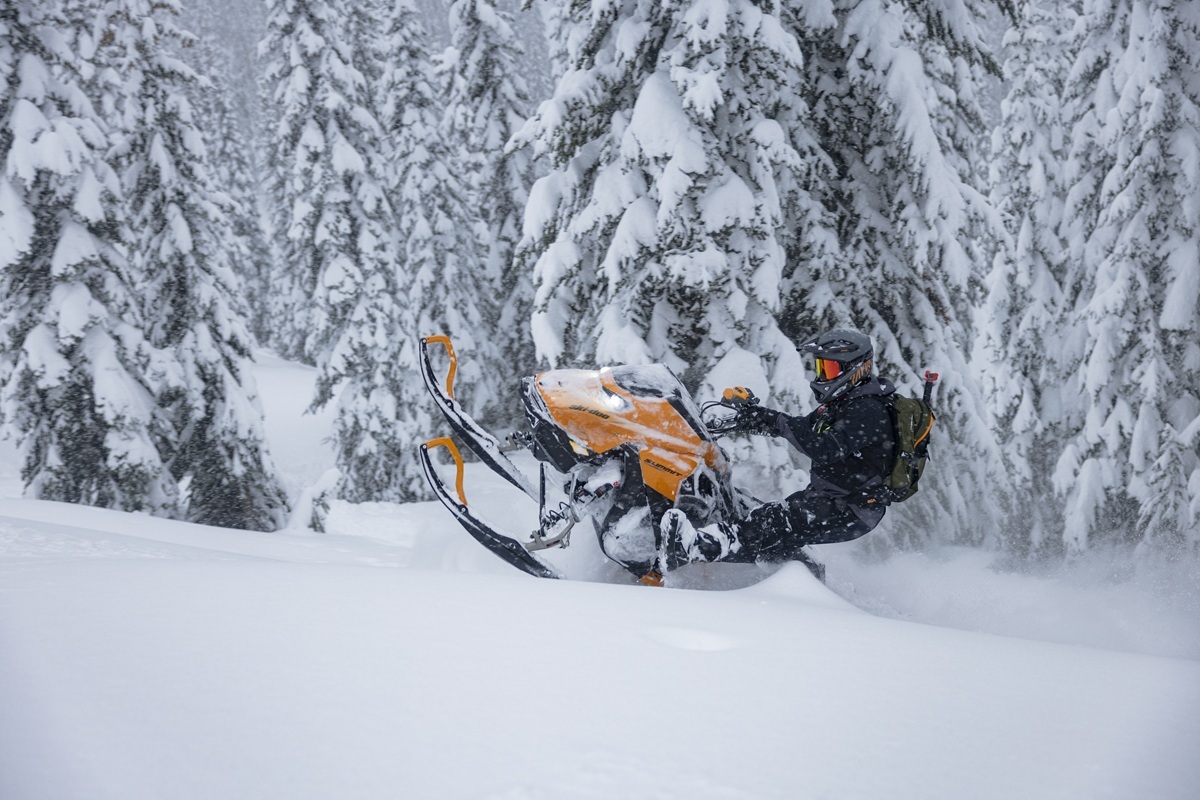
MATT PRUSAK: “The happiest customers are going to be the ones that push and ride it like an XCR customer does. So high-speed ditches, fast corners, jumps, bumps, moguls, that kind of stuff. Aggressive riders in demanding terrain riding fast are going to feel the biggest benefit from the technology. That said, you’ll still be able to trail ride the sled. And, again, our strategy is we’re trying to be stiffer, but not harsh. It’s still a good groomed-trail sled that really shines when it gets rough.”
NELS EIDE: “I have spoken before about how I grew up racing cross country sleds and then it was time to get a job. (laughs). But when you have a race sled or bike or whatever that’s tuned perfectly, when you really push it on the track or in the ditch or whatever, it gives a feeling back where it’s happy it’s getting pushed and it wants to keep pushing a little harder. It’s not unsettled. It’s not overwhelmed. It’s right there with you. And it makes you want to go a little faster. I think the new setup on the XCR does that.”
MATT PRUSAK: “We didn’t talk a lot about the handling improvement. We talked about bottoming resistance and aggressive riding, but the key ask from the cross-country team was to go faster for model year ’24 and now from our XCR customers that are really aggressive with corner entry, corner exit and trying to keep the skis positive with the snow. That was a big improvement with this package as well, with just recalibrating the entire vehicle, stiffer IFS springs, stiffer torsion springs, and then the Long-Tail architecture. We were really aimed at aggressive on-throttle cornering as well, and keeping the skis glued to the snow.”
SG: So what about the finished product makes you and your team most proud?
MATT PRUSAK: “The first thing that I’m super proud of is how we leveraged racing to develop technology, and then trickled that down to customers at the right level and in the right spot. I’m super proud of the whole team’s effort there. Then, I’m super proud – similar to Nels – of just truly listening to our customers and adapting and making our product better. It’s really easy to just have bold new graphics every year, right? That’s the easy button for a manufacturer. But listening to your customers and translating that to improvements can really make a difference, I’m proud of that process. [The changes] might not look big on a spec sheet, but when you go ride it, it’s a massive difference.”