The Math Behind Ski Stance
Modern snowmobiles are equipped with all sorts of fancy technology these days. Examples include giant digital screens, heated seats, on-board navigation, self-adjusting shocks, case-specific tracks with monster lugs and general designs that employ many exotic and expensive techniques. It’s all done to make our lives even more fun in the winter.

Despite these advancements, modern sleds – whether dedicated for riding trails or mountain sides – still have many common, unchanged principles or design qualities that they’ve utilized for quite some time. For instance, sleds come with one track in the rear for propulsion and two skis up front that are set underneath spindles and suspension.
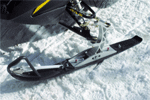
There have been advancements in shock absorbers, intense geometry changes to make sleds handle better and more in the evolution of the front end of a snowmobile. But one fact still remains: The two skis on the snow are separated by a case-specific distance – the ski stance.
Most folks know that ski stances vary, ranging from trail (usually the widest) to crossover (a little narrower) and mountain (usually the narrowest). Utility-focused sleds have been up and down the ski stance spectrum.
The trend of mountain sleds becoming narrower has been adopted by each manufacturer. Stances that used to be around 42 inches wide dropped to 40 inches, then to 38 and now hover in the 34- to 36-inch range. Conversely, trail sleds have increased in width from the old standard 38 and 40ish inches to now reaching about 43 inches wide. (Or, if you’re overseas on a Lynx 59 Ranger, you could be riding a sled with a whopping 59-inch stance.)
So what’s the science behind it all? A generalization would be that a wider sled is more laterally stable, meaning it absorbs more force applied laterally, than narrower ones. In the 1970s, the Snow Goer test team at the time demonstrated the effect by using a rollover tilt table to measure the angle at which each snowmobile’s upper ski began to lift. Typically, the wider the stance, the higher the tipping point.
Mathematical concepts found in statics (which is rooted in physics) in the mechanics education realm describes the behavior of physical systems when they are subjected to forces. The basic idea in statics is the equilibrium of forces, where no acceleration in any direction occurs – meaning the summation of forces and moments acting about an object must remain at 0. (Jumping into the next stage where objects move in space is another area of study known as dynamics.)
Assessing the amount of force required to tip a snowmobile up onto a single ski can be isolated using a few equations. Of course, a perfect physics world assuming many constant variables and perfect “spheres” or blocks is required to wrap one’s head around a few ideas, but the extrapolation and overall science illuminates the impact an inch one way or another may have on the overall riding experience.
Picture doing some typical in-garage maintenance where you need to tilt the sled up onto one ski to change a ski’s carbide runner. You push sideways on the handlebar to make the sled tip up onto one ski. Slipping versus tipping is partially the principle depicting how much force is required to make the sled lean or tip. (Big caveat: Yes, when we’re riding, we can weight-bias a machine with our body weight/positioning through the running board, which is a partially off centerline axis to one side, which in turn changes a sled’s center of gravity by squatting the shock slightly, etc. So, the math in this example is isolated to an at-rest, static case where perfect physics world happens.)
Enter the math and the statics. Free body diagrams illustrate the forces and moments placed on an object along with their spec dimensions.
First consider the force of the body pushing down on the earth. This is equivalent to weight in a different unit where F=m*a (force = F, m = mass, and a = the acceleration due to gravity). In metric units, F is expressed in Newtons (kg*m/s2), while Imperial is pounds (slug*ft/s2).
Moments are created when pushing on an object with an offset from center, creating turning about an axis equaling the magnitude of force multiplied by the offset distance from the center. By summing the moment of the snowmobile’s weight at its center versus the force exerted laterally at the skis point of contact at the ground, we isolate the force needed to tip – and the effect of increasing the ski stance on the total force required.
As one pushes laterally on the handlebars at a spec height (h) from the ground, if one overcomes the force that the opposite ski can support spaced a distance apart equal to .5x of the total stance (S), the sled will begin to tip due to the moment about the far ski contact point. This assumes infinite friction coefficient (or that the sled won’t slip on the floor at all means: We only care about tipping – not slipping across the floor). It would read like this: The force of the push times the height equals the force of gravity time times half of the stance, or Fpush*h=Fg*(.5*S). And then, solving the equation for the force of the push, it would be Fpush= (Fg*(.5*S)/h)
This indicates that the force required to tip the sled varies linearly at a slope of .5x the stance and height from the ground.
What if we’re not pushing completely parallel with the floor, and instead in an upward direction?
Remember how statics requires the summation of forces to equal 0 in both vertical and horizontal directions? We’ll effectively decrease the weight of the sled pushing downward into the floor by the magnitude of applied force relative to the sine of the angle to the horizontal, while also decreasing the effective lateral tipping force by the factor relative to the cosine of the angle. Yes, you may have gladly left all of the sine/cosine/tangent mumbo-jumbo behind years ago in your trigonometry class, but engineers still deal with it every day!
Putting all of that into an equation, summation M provides about the same point (opposite ski) shows that Fg*(.5*S) = Fpush*cos(θ)*(h) + Fpush*sin(θ)*(S), or solving against for the force of the push, Fpush = (.5*Fg*S) / [h*cos(θ) + S*sin(θ)]. Easy, right?
If holding the height of application of force constant between both cases (pushing laterally against an upward angle), the magnitude of the force required to cause tipping is still intimately linked to the stance, or “S” in the equation, albeit through their respective trigonometric multipliers.
What does this mean for you in riding land? In theory, its possible to calculate how much effort it takes you in every lean or turn to cause that ski to lift. (Kind of…just watch your units. Slugs and kilograms and Newtons and inches and meters and feet per second, oh my!)
In reality, these types of equations are only the base of sorting through how a sled will interact with its driver on a given ride due to changes in width, weight, length, height, etc., as well as the surfaces being crossed. If we free up variables such as changing the center of gravity, how shocks will actuate or even how the sloshing of gasoline in the tank provides a ‘surge’ of acceleration to one side which aids in lift… There are countless iterations and simulations factory engineers can and do run on each machine to guarantee a layout they deem fit for their customer base.