Building Inspiration – Innovative High School Program Creates Winning Confidence
Located on the rural prairies of southwestern Minnesota, where the soil is luxuriously black and rich and the landscape is so flat you can watch your dog run away for three days, Bold high school appears outwardly like many other aged small-town schools.
But there’s something special going on inside the nearly century-old building on weekdays – some of the results of which can be spotted on laketop speed run racetracks on winter weekends.
Bold high school is home to a cutting-edge small engine shop class program where the students learn first-hand how to fix anything from lawn mowers to ATVs to snowmobiles and beyond.
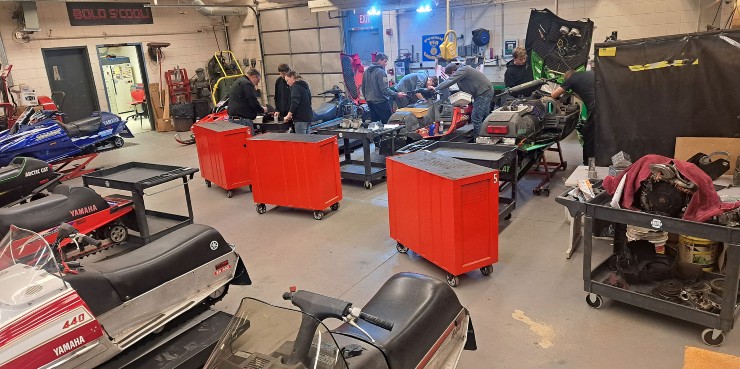
The snowmobiles, though, are the stars of the show. On a December visit, we found the shop filled with 10 sleds, and students of varying skill and confidence levels tuning carburetors, chasing down electrical gremlins and even rebuilding the top-end of a two-stroke.
That was impressive on its own. But select students also participate in speed run racing on winter weekends as a part of the program’s Black Max Racing Team. The 16- to 18-year-olds compete at sanctioned events against adult racers while guiding high-powered Yamahas at speeds exceeding 100 mph.
The teens don’t just race, they also tune their snowmobiles between runs, expertly dialing in clutching and jetting in an endless effort to gain iotas of speed.
Through it all, the classes are giving young learners a practical education, confidence and, for some, a reason to finally enjoy going to school. It’s also potentially creating future powersports mechanics, snowmobilers and racers while being a shimmering beacon for other school shop programs.
The Foundation
Formed in 1992, the Bold school district is an amalgam of once separate schools in Bird Island (population 977), Olivia (2,289) and Lake Lillian (246) in a particularly rural part of Minnesota. The high school, found on the south edge of Olivia, showed its age but otherwise looked tidy but unspectacular when we circled the building on a crisp December morning.
Curiously, though, a lettered-up Black Max Racing trailer sat in an adjoining parking lot, and a half-dozen snowmobiles of various ages were cued up outside a service door, despite the fact that there was no snow in the surrounding farm fields.
Once we were buzzed inside the school, Rob Van Der Hagen – a former multi-location NAPA auto parts store owner and lifelong snowmobiler who is now the school’s industrial tech teacher – took us down the hall to his laboratory. While he described the basics of this unique program to us in an otherwise abandoned classroom, we could hear air compressors engaging, power tools grinding and exhaust fans humming in the adjoining workshop. His students were hard at work.
Van Der Hagen was talked into being a shop teacher in 2021 after he sold his NAPA businesses and had time on his hands. But if he was going to take the job, he insisted he had to do some things his own way.
“I run my classes like a business, we do not run them like a school program,” Van Der Hagen explained. When students sign up for the class, he said, “they are an employee who now works for me, and of all of the work we do in here, 99 percent of it is for customers – people in the community outside of school.
“I’m not a fan of personal projects – personal projects never get done or they get dragged out,” he continued. “But if I have a student working on Joe Smith’s snowmobile and snow is coming, Joe wants it now and there’s a level of urgency that gets applied to that kid, and now that kid has to go to work, perform and finish the job. It’s not optional.”
He cited another example of an ATV engine swap the students did for an 85-year-old man who needed his quad fixed before hunting season. “All of the rules of customer satisfaction, doing the best we can and making everything perfect all applies. It’s about the only class that they will take in high school that holds them to that standard. The joke in here is that you’re either going to get an A or you’re going to get fired.”
Many kids who sign up for Van Der Hagen small engine or welding courses are mechanical novices, he said. At first, he’s teaching them the difference between a flat-head and a Phillips screwdriver. He also has them empty and sort a bin of hand tools, something that can be helpful for many students who maybe don’t do well in book-based classroom settings.
“They maybe had to try to learn fractions on a sheet of paper, but they don’t know them in the real world,” Van Der Hagen said. “But when they put the kits back together, the tools teach the kids. Now it makes sense to them – it’s actually applied. They see that a ⅜-inch socket is a little bit bigger than a ¼-inch, and why that matters.”
That said, students spend limited time in the classroom – he quickly transitions them into the shop and gets them touching actual small engines. And once there, he doesn’t hand them step-by-step instructions – instead, he assigns them machines with problems that they must figure out.
Fixing Stuff
To get machines to repair, the school turned to the local community. Once word got out, the class was flooded with non-running lawn mowers, snowblowers, golf carts, ATVs and snowmobiles, Van Der Hagen said. Some were donated, but most were from “customers” who pay for the needed parts but get the labor for free (though some will make a financial donation after-the-fact to support the program).
In the early fall, lawn and garden equipment dominates the shop, with a lot of fuel system and spark problems. By late fall, the shop starts seeing bigger problems on ATVs and UTVs, and soon thereafter snowmobiles start trickling in.
During our December visit, 10 sleds were at specific work stations in the impressive shop. Three were race sleds and the other seven were in for repair. An Arctic Cat ZL 500 with the hood up wasn’t pulling up fuel, Van Der Hagen said, while the sharp looking 1979 Yamaha Exciter had an ignition problem. The previously mouse-infested Polaris Indy Lite 340 required plenty of attention as it hadn’t run in 10 years, he said, and the Yamaha Vmax 600 needed a top-end rebuild.
Van Der Hagen drifted about the room, showing one entry level student how to gap spark plugs and then speaking up after seeing three students attaching a new piston. “Don’t put the cylinder on yet – it still needs to be honed.” But in general, the students worked with impressive independence.
The Race Team
Bold School District Superintendent James Menton stopped by Van Der Hagen’s shop class during our visit. Casually dressed in a polo shirt, he didn’t appear like a traditional, stuffy school administrator, and he wasn’t.
Menton was the man who first talked Van Der Hagen into being the school’s shop teacher. But Menton admitted to feeling more dubious when Van Der Hagen soon thereafter pitched the idea of starting a race team with students as drivers.
“I hate saying ‘no’ when teachers or anybody brings an idea, my philosophy is always to look for ways to make things happen,” Menton said. “But when he asked about snowmobile racing, I thought, ‘Ooooh, I don’t think we can do something like that.’ So instead I said, ‘I’ll run it past the attorney.’”
Because you figured the attorneys could be the “bad guys” who said no, we asked.
“Yeah, pretty much!” Menton said with a laugh. “I was pretty sure that they were going to say ‘No’ and I was fine with that. And they did. But then Rob kept pestering me about it. He said there are virtually no injuries in this sort of racing, and pointed out that there are way more injuries in any football game. They were good points, and I started liking the idea, so we kept pursuing this with the attorneys. Eventually we found a way to limit our liability and did it.”
During our visit, three of the four race Black Max Racing Team sleds were in the shop: a 2003 Yamaha RX-1 and a 2000 Yamaha SRX 700 were both on lifts, while a sweet sounding 1996 Vmax-4 800 with Aaen pipes sat on the shop floor. The fourth sled, a black 1994 Yamaha Vmax 600 for which the team is named, was out in the trailer.
Each of the immaculately clean sleds (three of which Van Der Hagen owned and previously raced with his son) featured lowered suspension setting and heavily studded tracks that reflected their intended usage on an ice drag strip.
Hovering near one of the sleds was Anthony Wittman, a 17-year-old senior from Lake Lillian and one of this year’s drivers. He admitted to being mechanically limited when he first joined the class two years ago. Now he talks confidently about reclutching the sleds between runs at race events. A field trip the previous year to tune a sled on a track dyno with Jason Houle at Straightline Performance proved particularly educational, he said.
Race Weekends
During the week, the race team members expertly tune and prep the race sleds. On weekends, they show up at sanctioned races and enter multiple classes in 1,000-foot speed run racing.
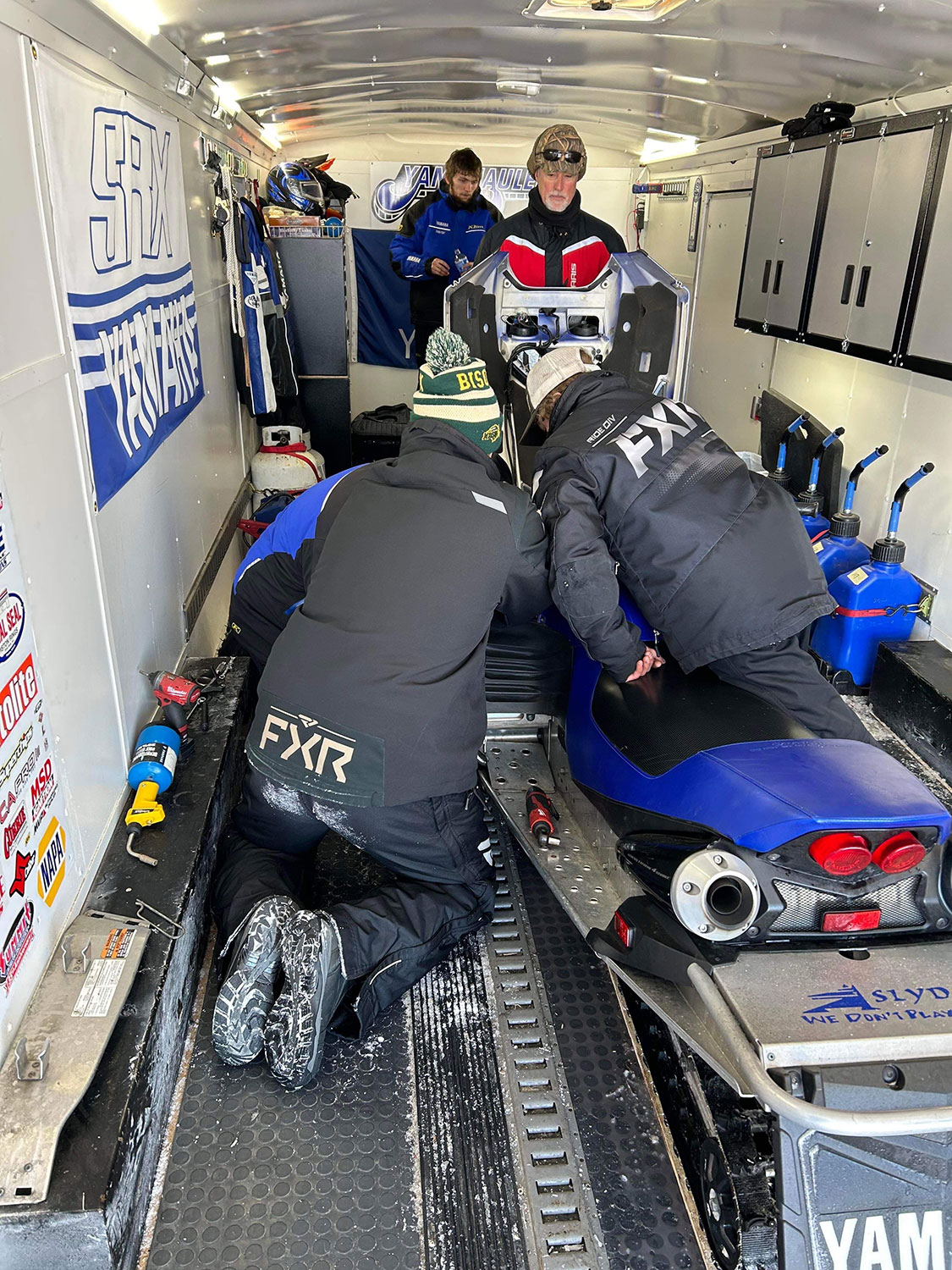
“Over about six hours on race days, they’ll run the four sleds four or five times each – that’s a lot of runs,” Van Der Hagen said. “I spend the majority of my time at the starting line lining up whoever is coming next. So what will happen is, a kid will make their run, then they come back and stop at the starting line and ask how fast they went. Then we’ll talk about what our next changes are going to be.
“Then they take their sled back to the trailer and they make the changes,” Van Der Hagen said. “Nine times out of 10, I am not in there with them – there might be another driver in there to help them, but the kids make all of the changes and log [the changes] on the bulletin board along with their speeds. Then when they’ve got it all buttoned-up they head back out and they do it again.”
Throughout the day, the students see results of their changes first-hand, which reinforces their efforts and instills confidence, Van Der Hagen said. “But we don’t go there just to compete – we go to win.”
Indeed, the school hallway now features a huge inset case featuring the Black Max team’s trophies plus photos of the race team. The team has been featured in local and national media and has an impressive following on social media.
“Traditionally, when you hear the term ‘shop kid,’ you think of kids who don’t want to do anything, they’re not an athlete, they can often be off by themselves or feel like they don’t fit in,” Van Der Hagen said. “They have never experience competition – nothing at school challenges them that they want to compete in. Grades certainly aren’t it, biology isn’t going to do that.
“I’m a firm believer in having something to strive for. That feeling of winning and what it can do for you is incredible,” he continued. “It’s paramount in business, you want that to be successful, but some of these kids have no idea what that feels like. Well, you put them on a race team and we’re competing against veteran guys who spend tens of thousands of dollars, yet we do very well.
“And when these kids win and they get their picture on Facebook holding that trophy, and when they walk into school and are now officially the fastest kid in school because you did 110 miles-per-hour that past weekend, it literally changes the kid,” Van Der Hagen said. “I have seen a kid who was failing, hated everything about school and was ready to drop out, who now is here at 7:30 a.m. every day during race season, wanting to know what we are going to do to the sled that day.”
Building A Future
Though the program is just three years old, one of Van Der Hagen students has already become a professional welder, another works for a manufacturer and a third works at a local dealership fixing golf carts and powersports equipment.
Still others have gotten enthused about snowmobiling and snowmobile racing. Wittman, for example, said with a grin that post-graduation he’s hoping to build his own race sled and challenge Van Der Hagen on the track.
Training future techs and boosting snowmobiling were two of Van Der Hagen’s stated goals. But overall, he’s hoping the classes inspire kids who otherwise may slip through the cracks.
The attention the program has gained has also created a stir beyond the southern Minnesota farm fields. Van Der Hagen’s been contacted by shop teachers far and wide who would like to do something similar.
“This has all the potential of becoming a state high school league competition,” he said. In town, he and Superintendent Hagen said there hasn’t been a single objection to the 100 mph speeds. “My take on it was, how did that conversation go when the first person walked into a superintendent’s office and said, ‘Hey, I want to have the kids shooting shotguns for trap for high school?’ So, it can be done.”