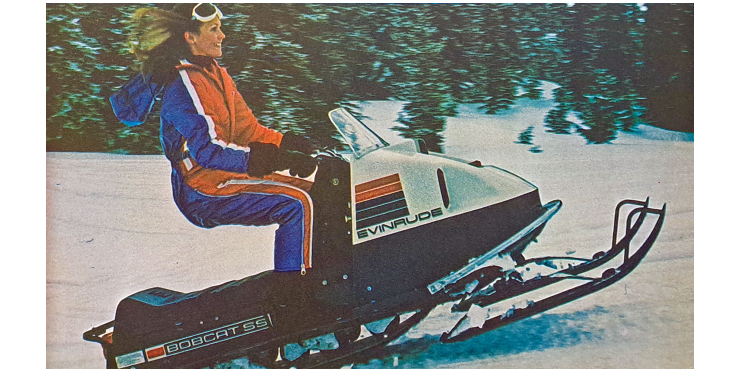
1973 Evinrude Bobcat SS: SSTuck in the SSixties
In June 1964, Outboard Marine Corporation (OMC) became the first big name manufacturer to enter the rapidly expanding snowmobile business. Producing robust, well-engineered sleds with advanced features under the Evinrude and Johnson brand names for the U.S. and the OMC Snow Cruiser label for Canada, the company quickly became one of the industry leaders.
OMC advancements to the state of the snowmobile art began with the first reed valve engines in the sport, even if they did call them leaf valves. OMC was also one of the first with an ignition switch as an anti-theft measure, helped pioneer use of a torque-sensing driven clutch for better performance, and was an early adopter of reliable capacitor discharge (CD) ignition and the convenient parking brake.
And on July 13, 1967, OMC acquired Trade Winds Camper Inc. including the Trade Winds snowmobile line. It was folded into OMC’s existing sled business and use of the Trade Winds brand name was discontinued.
Entering the 1970s, Outboard Marine’s competitive position in snowmobiling was beginning to erode as competitors innovated and improved while OMC let its lineup get stale. The 1973 Evinrude Bobcat SS provides a great example of what happened.
Yesterday’s News
The Trade Winds-based Bobcat series had been part of Evinrude’s lower end offerings since its 1969 introduction, and hadn’t really changed much since a mostly visual restyle for the 1971 season.
Smaller, stripped down and sort of sporty compared to the bigger, heavier and more expensive Evinrude family models, the base Bobcat was the price leader. The Bobcat SS with its “racing seat” was the closest thing that Evinrude had to a performance sled. It was loud, and said to be fast for its day, but only on a very smooth surface.
Despite the snowmobile industry hitting a new unit volume record in model year 1972, the Bobcat series wasn’t selling very well in a market that was becoming increasingly performance conscious. By November 1972, Evinrude dealers were advertising left-over ’72 Bobcat SS units that had originally listed for $1,325 at just $899, a whopping one-third off list price.
The upgraded ’73 Bobcat SS received numerous improvements including full engine enclosure, new intake silencer and a much-needed improved muffler. Together, they helped the sled meet new sound rules. There were also multiple lighting system upgrades and a slight price reduction.
But the SS was still essentially the same old Trade Winds derivative with what the snowmobile media derisively describes as BNG, or “bold new graphics.” The improvements really did not help Evinrude in a market that was seeing annual engineering breakthroughs that made many models totally obsolete in just a couple of seasons.
When Snow Goer evaluated the ’73 Bobcat SS, our editors at the time said, “It’s not for the ‘sitter,” a statement that highlighted the ride quality problem with its bogie wheel rear suspension in what was fast becoming a slide rail world. Some of the Bobcat’s handling shortcomings were chalked up to the fresh deep snow that it was tested in. Our testers also noted that it required leaded premium gas.
On the plus side, the power-to-weight ratio was deemed to be pretty decent. Actual power delivery to the track was still better than average despite the outdated center track drive concept, the sled responded well to pressure on the handlebars and rider body weight shifts, and OMC dealer service was cited as a plus in that era of many sub-standard snowmobile dealerships.
But when compared to newer performance trail sleds like the red-hot Rupp Nitro, the powerful Chaparral SS/III, the sleek Arctic Cat El Tigré (and its many free air companions), the sexy Skiroule RTX and the revolutionary liquid-cooled Brut, among others, the Bobcat SS had become simply a performance pretender.
Self-Destruction
The Bobcat was well built, but it showed why OMC was becoming increasingly irrelevant in 1970s snowmobiling.
The sled retained a heavy steel chassis when most manufacturers were going to lighter and non-rusting riveted aluminum construction. It still had the leg-breaker stirrups that were under heavy fire from the medical establishment and snowmobile safety critics. And bogie wheel suspension and no ski shocks didn’t cut it any longer, as most other brands delivered a far better ride on their performance sleds and even many entry-level models.
The increasingly dated tunnel-mounted, opposed-twin powerplant offered some advanced features including reed valves and CD ignition, but it no longer made anywhere near competitive power. A speedo and tach were extra-cost options, and the old-style center-drive track was flat out obsolete.
OMC tried to make its snowmobiles relevant again with the advanced Evinrude Skimmer and Johnson JX sport models that replaced the Trade Winds-based Bobcat/Norseman series and its Johnson equivalents for 1974. But it was too late. The company had stubbornly stuck with obsolete ideas for too long.
OMC departed the snowmobile business after the 1976 season. I’ve always felt that losing Johnson and Evinrude was a big loss for snowmobiling, but the company brought it upon itself by not staying competitive in a market where it had once been an innovative major player.
SPECS
Manufacturer: Evinrude Motors Division of Outboard Marine Corp., Milwaukee, Wisconsin
POWERTRAIN
Engine: 437cc OMC air-cooled reed-valve opposed twin with one Tillotson HD-37B carb, external fuel pump & filter, OMC Firepower capacitor discharge ignition (CDI), and twin pipes into dual OMC mufflers
Compression ratio: 8:1
Lubrication: Pre-mix at 50:1
Power output: 32 HP @ 6200 RPM
Clutches: OMC torque-sensing system with neutral lockout
CHASSIS
Type: Welded and painted steel with stirrups, chromed tube steel bumpers, and fiberglass hood
Weight: Not Available – OMC refused to discuss weight
Front suspension: Triple-leaf springs
Ski stance: 27 inches
Rear suspension: Bogie wheels (15 on 3 trucks) with torsion springs
Track: 15.4-inch wide 3-ply nylon with steel reinforced molded rubber and center drive
Brake: Mechanical disc with parking brake
Fuel capacity: 6 gallons
Standard equipment: Compression release, primer, choke, kill switch, snowflap
Options: Speedometer/odometer, tachometer, tall windshield
MSRP: $1,275