Just when it seemed like the so-called 50/50 crossover market was coming into focus, it’s been blown wide up again in the past couple of seasons!
About 20 years ago, so-called two-stroke on-trail/off-trail “crossover” snowmobiles were merely sleds with mid-130-inch tracks – early Renegade, Switchback and Crossfire models come to mind.
But as traditional trail sleds’ track length crept into the 130s, the crossovers stretched into the 140s. Center grab straps started to appear on handlebars, then wider skis and taller track lugs were added.
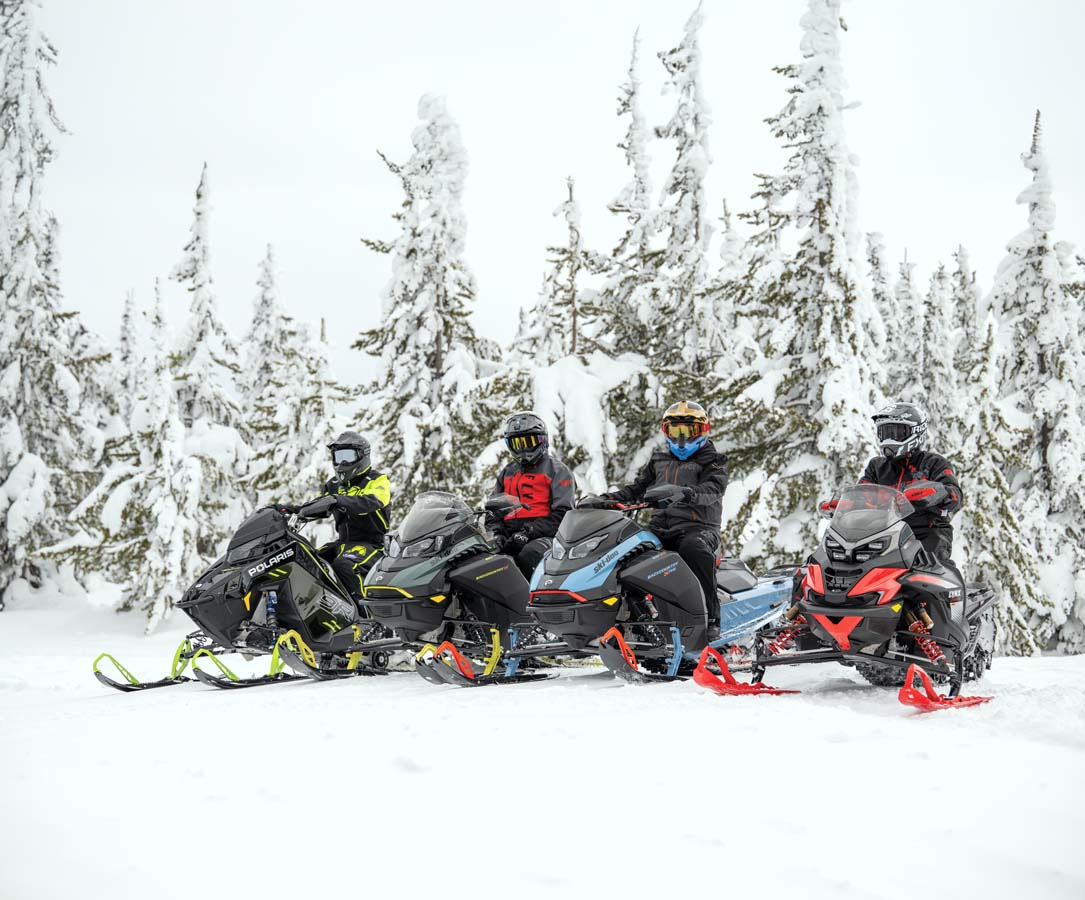
Soon, narrower ski stances became the rage as more customers envisioned themselves as off-trail warriors. At roughly the same time, monikers like Backcountry, Switchback Assault and Riot were chosen to better distinguish the 50/50 machines from their trail-focused siblings.
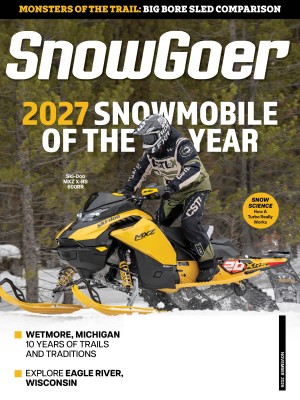
This article originally appeared in the November 2025 issue of Snow Goer magazine. That means you could have enjoyed it long ago if you only subscribed! Go ahead and sign up today to get the print or digital edition of the magazine and feed your love of the greatest winter sport ever created.
As the 2020s approached, the two-stroke crossover segment seemed to settle into two camps. Riders seeking a crossover with more deep-snow capabilies could opt for the narrow Ski-Doo Backcountry or Arctic Cat Riot X models. Those who wanted a wider, trail-leaning sled could get a Polaris Switchback Assault or Arctic Cat Riot (without the X).
Lynx soon joined the party with its rowdy Xterrain models that were wide, a bit hefty and outfitted with high-end, big-bore shocks aimed at jumping and hard landings.
Things sharpened further when Cat combined its Riot and Riot X two-stroke models in the new-for-2024 Catalyst chassis into a singular model with a 38- to 40-inch adjustable stance. That made the Cat and Ski-Doos the narrow options while the Polaris and Lynx were the 42-inchers. Simple enough.
But maybe it was too easy? Ski-Doo scrambled the math for 2025 by offering a 43-inch-wide option for its Backcountry X-RS featuring trail-focused front suspension geometry and skis. Now Polaris – previously the king of the wide crossover – has released its new-for-2026 narrow Switchback Assault option. Whew!
All of this back-and-forth leads to one obvious question: What exactly is a 50/50 crossover? No other class in snowmobiling has a definition this fluid. We set out to find answers, but we were hamstrung by the odd mishmash of snowmobiles the manufacturers brought to the Rode Reports/Snow Shoot event.
• Arctic Cat didn’t attend the 2026 Rode Reports/Snow Shoot due to its ownership transition.
• Lynx only brought one Xterrain RE model, and it featured a hefty 900 ACE Turbo R four-stroke.
• Ski-Doo brought three Backcountry models, but all had the 43-inch-wide front end, with no 39-inchers in sight.
• Only Polaris brought enough for a true comparison, with wide and narrow versions of the 9R Switchback Assault.
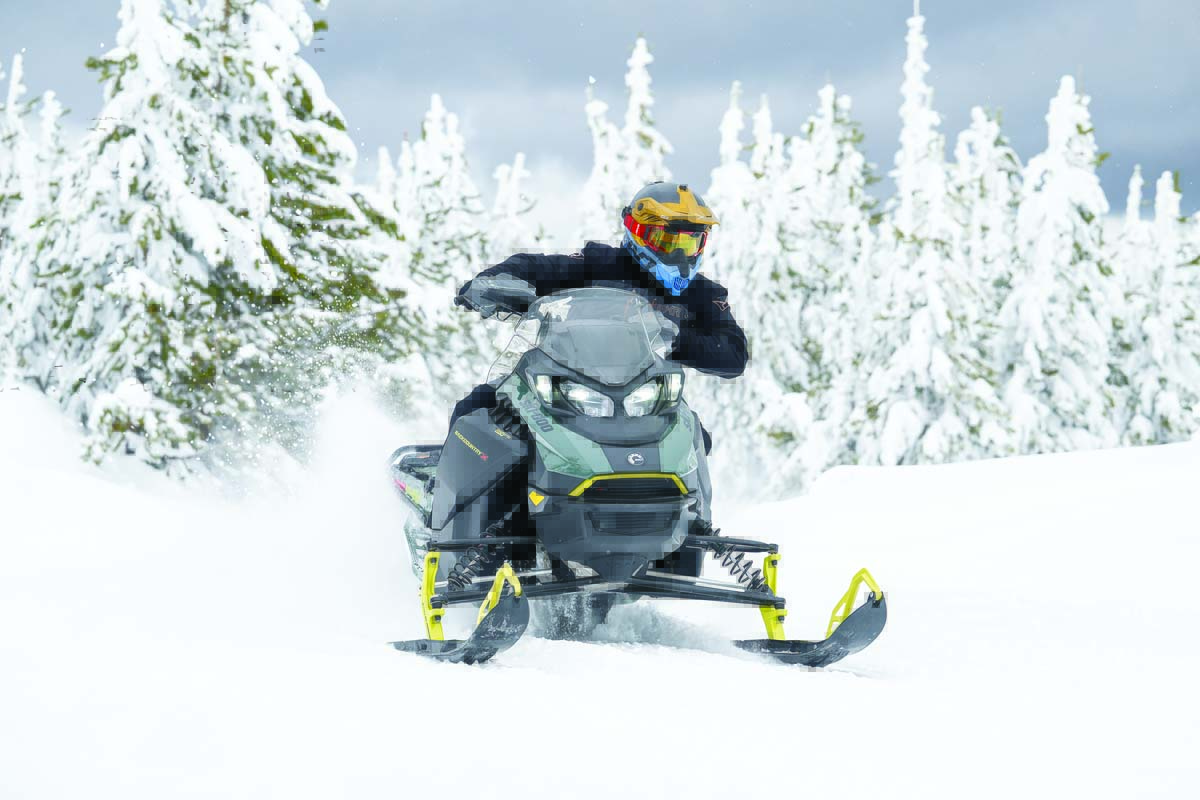
Ski-Doo Backcountry X 850 E-TEC & Backcountry X-RS 850 E-TEC Turbo R
Many of our regular readers are likely tired of hearing this opinion from us, but when it comes to creating the near-perfect blend of off-trail nimbleness and on-trail handling, our test team thinks Ski-Doo’s Backcountry does it best.
That may be best-reflected elsewhere in this issue, where – once again – we’ve named a Backcountry model to our Top 10 snowmobiles list as the best 50/50 crossover.
However, it should be noted that our team’s affection for the Backcountry is with the original one with the 39-inch ski stance. And that machine was not available for this test.
Instead, Ski-Doo left the defending champion at home and brought a fleet of its new-style Backcountry models, all with 43-inch-wide front ends. First introduced for model year 2025 on the Backcountry X-RS model, the 43-inch package is being spread deeper into the Backcountry lineup in 2026 as an option for X and Adrenaline models.
Before we left the staging area where all of the sleds were parked, we said, “Give us every Backcountry you’ve got – we’ll compare them.” We ended up with a wide X-RS model powered by a turbocharged 850 two-stroke, and a wide X model equipped with a naturally aspirated 850 twin.
For the seat-of-the-pants testing we’d be doing, separating an X package from an X-RS left little room for differentiation, but we were curious to see how much having the extra power and weight of the turbo in one sled would separate it from the other – both on and off the beaten path.
Defining The Wide Backcountry
When Ski-Doo introduced the world to its new RAS RX front suspension geometry and Pilot RX skis for model year 2025, it predictably showcased it on its high-end MXZs. That made sense: Where better to showcase a package that better controls body roll and plants the skis to the ground than on your most aggressive trail burners?
In that context, it was rather shocking to see that a 2025 Backcountry X-RS model – not a Renegade – was the other vehicle to receive this combination. Our first thought was, “Hold on a cotton-pickin’ minute – isn’t a crossover supposed to roll the front end more to help create fun on laketops and in powdery meadows?”
In truth, Ski-Doo wasn’t building this new Backcountry option for its traditional crossover riders. Instead it was aiming at a different audience – as evidenced by the 43-inch stance and trail-focused skis. And for 2026, that approach spreads deeper into their lineup.
On review, compared to the RAS X geometry on the “regular” Backcountry, the RAS RX package includes taller spindles and higher-mounted A-arms that are farther spread apart. There’s also flatter-mounted shocks, new sway bar linkage, a new lower steering arm mount and increased travel.
Combined, Ski-Doo says this new geometry reduced body roll by 20 percent by moving the sled’s roll center closer to its center of gravity. The wide Backcountry also uses Pilot RX skis with more aggressive, two-step keels.
Otherwise, the rest of the machine stays the same – including the REV Gen5 chassis platform, narrow seat and the uncoupled cMotion rear suspension.
To be abundantly clear, the original Backcountry with the 39-inch stance, RAS X front suspension geometry and wider Pilot DS 2 skis still exists. Oddly, there isn’t a different name for the new vs. the old model, or the suspension package. Internally, Ski-Doo calls the wide-stanced package the “S-43,” but outwardly the difference between the two models is just which box is clicked when ordering. (That could make things interesting on the used market in coming years?)
Separating the two wide Backcountry models in our test, the X-RS model carried the 180-horsepower Rotax 850 E-TEC Turbo R, a recoil plus the SHOT hot-restart system, a 15- by 146- by 1.5-inch Storm track, upgraded KYB Pro EA-3 shocks, reinforced rails, a four-piston brake caliper and an adjustable brake lever. As tested, it carried a $22,149 MSRP and its spec dry weight was 500 pounds.
Our Backcountry X demo model, meanwhile, was motivated by a naturally aspired 850 E-TEC twin rated at 165 horsepower. Compared to the X-RS, it came with electric start that uses a battery, a 15- by 146- by 1.5 Ice Storm track with pre-studded lugs, mid-level KYB Plus shocks at three points (with a KYB Pro EA-3 on the rear arm), a two-piston brake caliper and fixed-position brake lever. As tested with the upgrade to the 10.25-inch digital display, its MSRP landed at $17,649 with a claimed spec dry weight of 464 pounds.
Divide & Separate
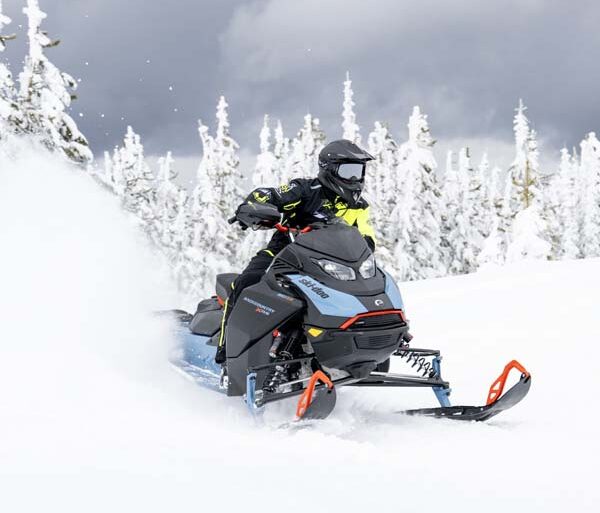
With both of these buggies being the wide Backcountry models, not surprisingly each were very much at home running groomed trails.
As promised by the new RAS RX geometry, the front end stayed flat on each machine and the skis stayed glued to the snow-covered surface as we weaved down a twisting trail. While the longer track and uncoupled cMotion skid frame prevented them from having true MXZ-like handling, they weren’t far off. Each machine was predictable, stable and fun. The track difference, in the conditions we rode, was neglible.
When we got into some trail chop, the cMotion skid frame impressed us once again. It’s doesn’t erase as much energy as an rMotion trail design, but for an uncoupled design it soaked up common trail chatter quite well.
We never found bumps big or rugged enough to fully sort out the difference consumers will feel between the shocks – much less testing the rail reinforcements. That said, previous experience with KYB shocks plus having the available clicker-adjustability on the X-RS model tells us it is the preferred option.
The turbocharged 850 in the X-RS demo we rode was particularly strong running, spooling quickly to provide a crisp feel and thrillingly long legs. Ski-Doo in recent years has dialed in its turbocharged engines for altitude much better than Polaris has with its Patriot Boost. The naturally aspirated 850 in the Backcountry X certainly felt stout and reactive, but it was outshined when compared to the turbocharged machines and the 9R on this ride.
“I would normally think I’d want a N/A motor in a crossover, but the turbo has such seamless power delivery and such a high fun factor, and there’s not a discernible turbo lag,” a tester said.
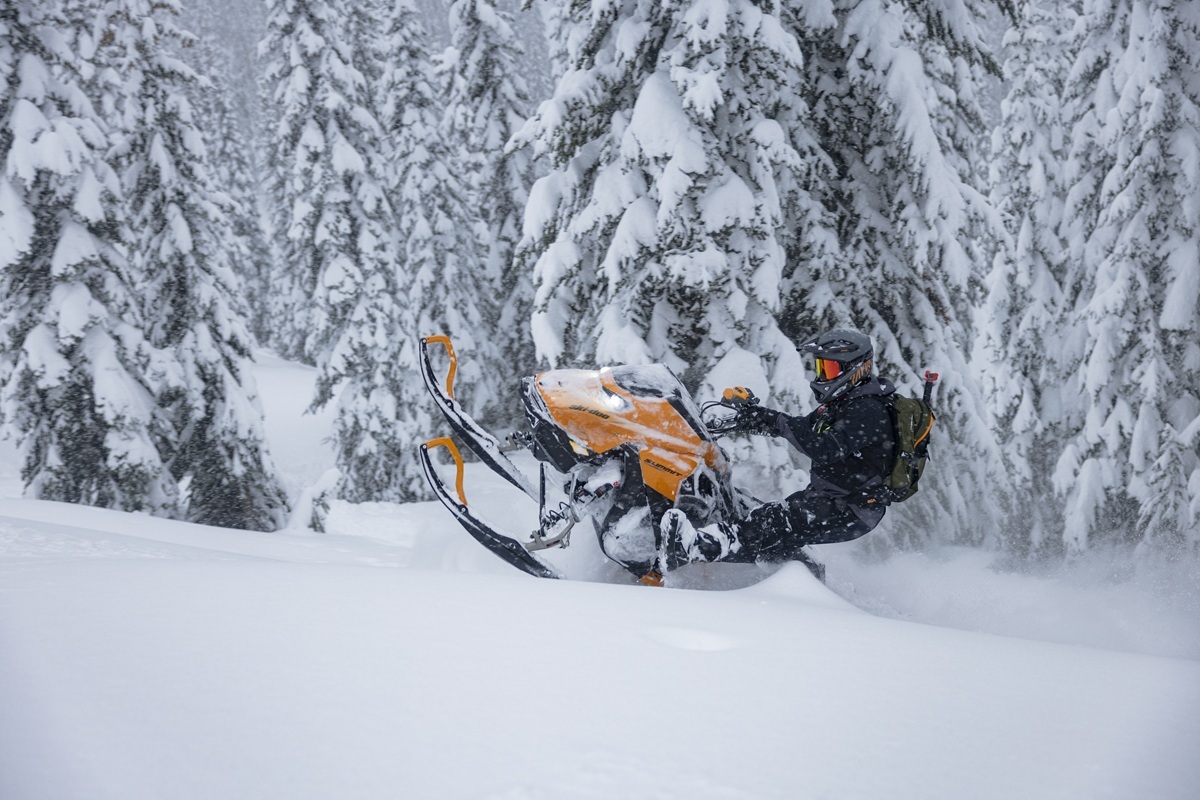
Off-trail, these two wide Backcountry models were merely OK. The same planted feel we appreciated on the trail was replicated when trying to play in powder or hold a line on a hillside – both skis definitely wanted to reach for terra firma and the sleds were more difficult to hold on their sides. They lacked the playfulness of the narrow Backcountry models we adore.
Physics would suggest the lighter 850 X model would be easier to ride with one ski in the air, but the surprising crispness of the Turbo R in the X-RS let it hang close on the sidehill and negate part of the weight difference between the sleds.
Riders raved about the sleds’ open-feeling cockpit and the growing capabilities of the 10.25-inch gauge. But ultimately these wide Backcountry models were identified as 75-percent trail/25-percent off-trail machines – and not the true 50/50 crossover DNA of the narrow Backcountry.
“You could still do power turns and such, but you just felt like you were on a long trail sled rather than a crossover,” one rider noted. “I guess that’s because we more or less were.”
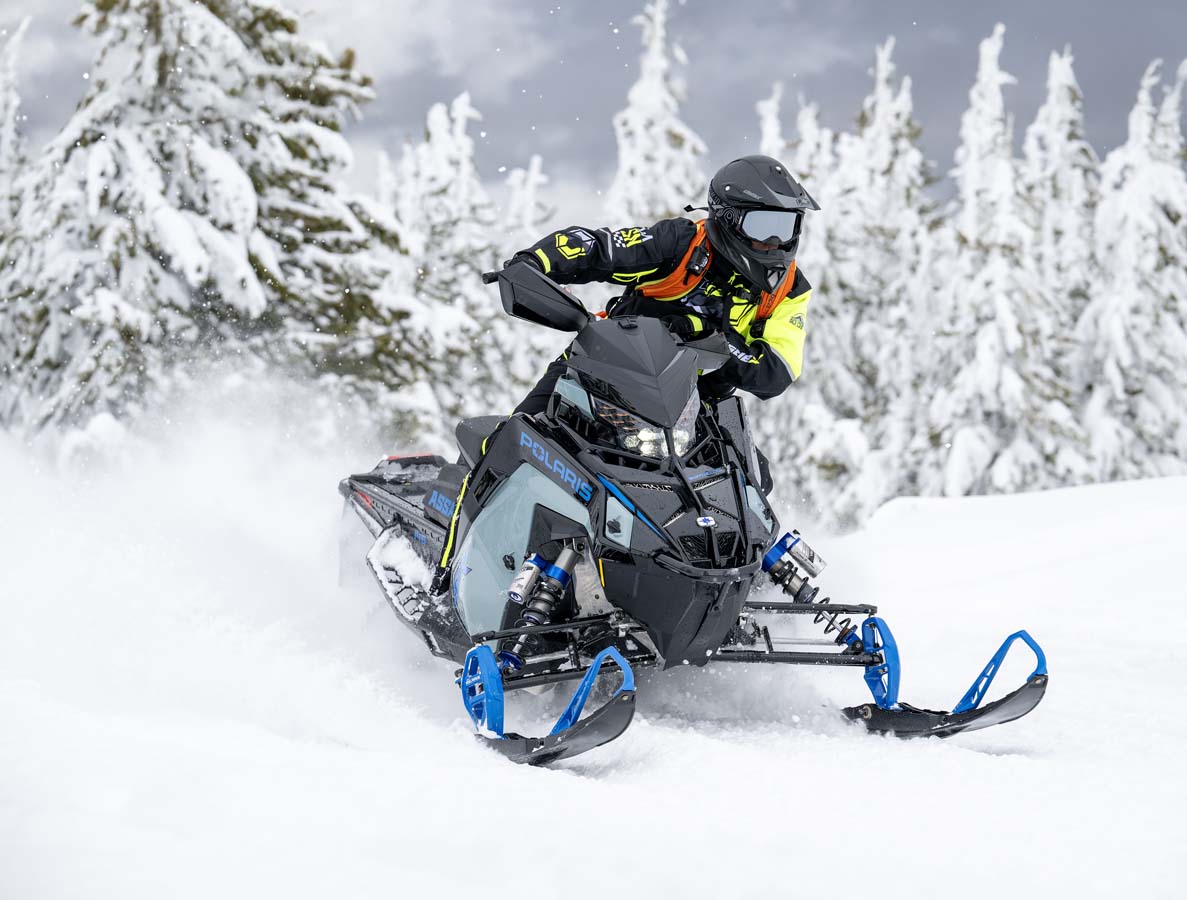
Polaris 9R Switchback Assault: Narrow & Wide
Because Polaris was unveiling a narrow Switchback Assault for the first time to go along with the original wide version, it was not surprising that the brand brought at least one of each to the 2026 Rode Reports/Snow Shoot event.
Like Ski-Doo before them, Polaris didn’t assign separate names for the crossover with a narrow front end vs. their original wide version. Instead, the new setup is a package option that a buyer (or dealer) can click when a 2026 Switchback Assault is ordered – like choosing a different track or windshield, we suppose, except with a significantly greater impact on the resulting machine and the way it performs and feels.
Polaris does, however, provide package names for the two different setups. The new option is called the Escape IFS front suspension. It features taller forged aluminum spindles that come directly off of the Pro RMK’s React front suspension. They give the sled more clearance and make it easier to tilt. But unlike the RMK, which runs on a 36- to 38-inch adjustable stance, the Escape IFS spindles tie into new forged aluminum A-arms that set the skis 39 to 41 inches apart.
The Escape package’s Gripper skis and smaller bore (1.75-inch) Walker Evans Velocity compression-adjustable shocks were also lifted from the RMK lineup.
The returning wide end on the Switchback Assault is called the Race IFS front suspension. The “Race” title has been in Polaris’ vernacular for a while. For whatever marketing reason, the official specs now refer to the brand’s trail-focused front suspension as the Matryx IFS, which ties the name to the chassis. But insiders still call it the Race IFS, and that name is now revived in Assault land.
The wide Switchback Assault rides on trail-focused Pro Steer skis that are set at a 42.5 inch center-to-center stance, with forged spindles and steel A-arms. Figuring this rider might be charging through moguls at a more aggressive pace, Polaris loads it with 2-inch-bore Walker Evans Velocity compression-adjustable shocks.
The only other notable difference between the models is that the returning Switchback Assault with the Race IFS is available with a buyer’s choice among four 146-inch tracks (Cobra with 1.35-inch or 1.6-inch lugs, a 1.5-inch Ice Storm or a 2-inch Crossover) whereas the Escape IFS buyer only gets two track options (1.6-inch Cobra or 2-inch Crossover).
Otherwise, both models come on the Matryx chassis platform, utilize the 7S digital display with on-screen mapping, turn Pro Taper handlebars and feature NightBlade headlights. Engine options are the Patriot 9R factory big bore, turbocharged Patriot Boost or naturally aspirated 850 Patriot.
For our test, we were pleased to be riding two 9R-equipped models. That not only made comparisons between the two front ends more direct, it also allows us to spend more time with perhaps the most fun stock engine in the sport right now.
Inches Matter
When Polaris moved its radical Switchback Assault crossovers from the Axys chassis to the Matryx chassis for model year 2021, there was debate among our test team whether the new rig was a step forward or a step backward. Our trail-focused riders thought the new chassis’ ergonomics, fit and finish and various top-notch features had moved the SBA in the right direction. But our off-trail-focused riders felt the new setup was not as playful, responsive and fun as the outgoing sled.
Apparently we weren’t the only ones debating the topic, as Polaris actually kept both Assaults in their lineup for a year before committing to its relationship with the new, more stable setup with its trail-first focus.
The Assault’s planted nature was appreciated on the trail, but the machine consistently came up short as a true 50/50 crossover in our comparison stories, especially when compared to the Ski-Doo Backcountry models, which gave up a touch of trail precision for far better off-trail playfulness.
After our ride on Assaults with the Escape vs. Race front ends, Polaris definitely proved that inches matter – a lot! These two machines felt dramatically different from one another, both on trails and in playgrounds. There is no yin-and-yang here: the contrast was stark. We consider that a good thing.
On groomed trails in varying conditions, the Assault with a Race IFS was stable, predictable and fun. Especially with the quick-hitting and strong 9R engine tucked between the side panels, it could definitely pull the skis up and be ridden radically on-demand, thanks to the long track, the uncoupled rear suspension and the big power. But if a rider so chooses, it can honestly be guided down the trail quite comfortably, like riding a long Indy XCR.
Bump compliance is decent once you dial in the Walker Evans shocks, and the Pro Steer skis held their line well as long as the rider properly timed their throttle inputs.
The Escape-equipped Assault, by contrast, was a bit unwieldy when we tried to ride it aggressively on trails. The taller spindles, higher front end and narrow stance combined to cause more inside ski lift and mid-corner corrections than we expected. Much more than the narrow Backcountry models we’ve ridden in the past.
“Tons of traction, tons of speed, but it’s just a workout to ride in these conditions,” one tester wrote after an aggressive spin down the South Plateau trail. “On trail, the narrow Assault is definitely a handful,” another tester wrote. “Its RMK heritage is showing through.”
A third tester wrote, “I was trying to keep up to the wide Assault in front of me through the twisties and was leaning very hard to try to get it to plant, but ultimately I just had to slow down before I ended up upside-down in the cabbage.”
As one might expect, the roles were reversed when we left the groomed paths for the playgrounds. That’s where the new Escape-based Assault strutted its stuff.
“I was so very pleased with it off-trail,” one tester wrote. “Great traction and nimbleness, you could just lay it on edge and carve or let it dangle between trees. It’s a huge improvement over the traditional SBA.”
Another test rider wrote, “Off-trail, especially with the reactive 9R engine, that’s the most comfortable and confident I’ve ever felt on a Polaris crossover in steep terrain. I could easily pop over things, make late decisions and corrections and be more aggressive in deep snow.”
The wide Assault, meanwhile, had a familiar – and somewhat cumbersome – feel when in deep snow and off-kilter.
“The narrow skis would knife through the powder and when you wanted to hold a single ski in the air it was constantly wanting to flop back down,” one tester said.
“I softened the shocks to get more roll in the front end, which helped a bit, but the wide one is definitely a trail sled first,” another test rider wrote.
Wrapping it up, a test rider said, “The difference between the narrow and wide Assaults is very significant – more so than on the Ski-Doos we tested last year. Choose carefully because each is very, very good at one thing – trail vs. off-trail – and not nearly as good at the other.”
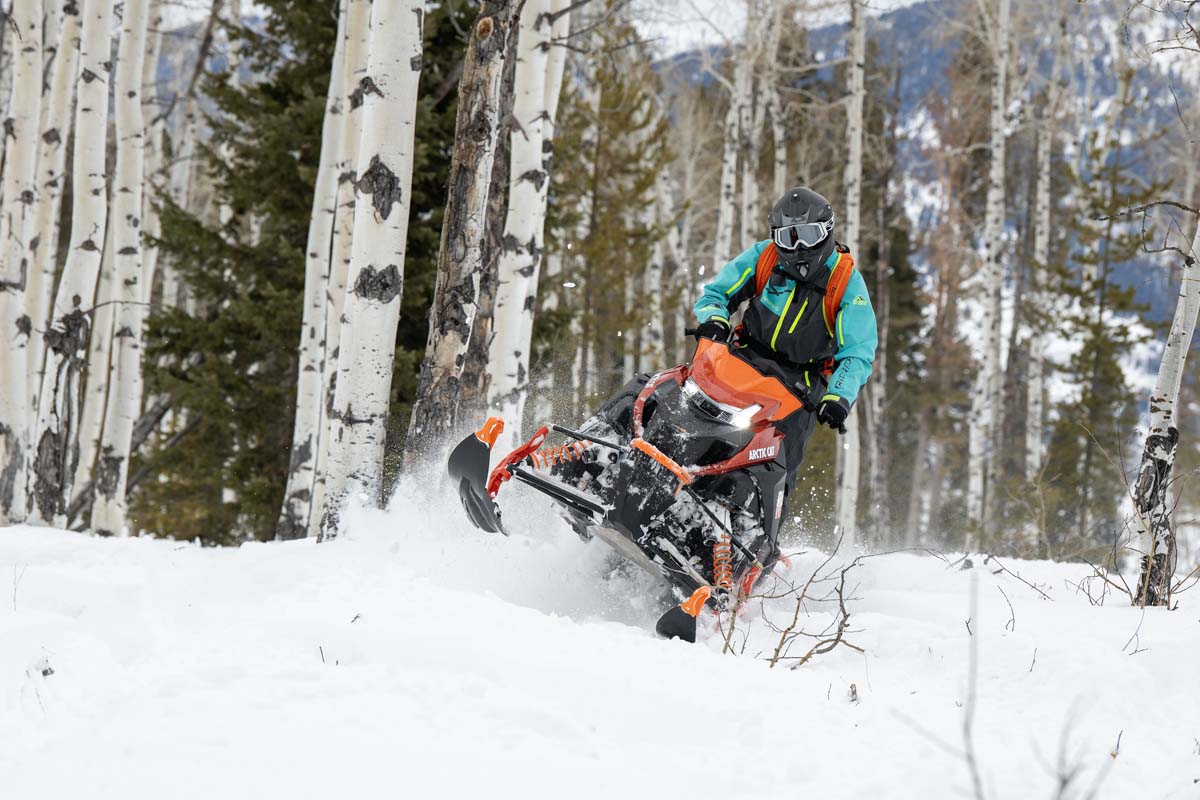
Arctic Cat Riot 858
Given that it was forced to take some much-publicized time to reorient its ownership structure and put the Textron era firmly in the rearview mirror, Arctic Cat unveiled a surprisingly deep 2026 snowmobile lineup on April 25 through a powerpoint with computer-generated pictures.
Specific to the crossover category, six machines will carry the Riot moniker. They include single-cylinder Riot 400 and Riot Touring 400 models in a downsized chassis, plus a Riot 9000 EPS ATAC that’s essentially a long luxury touring version of the Thundercat with power steering, a heated seat, a 146-inch track and monstrous turbocharged four-stroke power.
Most relevant for this article are the sporty two-stroke-powered Riots in the modern Catalyst chassis. They are the Riot 600 Sno Pro, Riot 858 Sno Pro and Riot 858 ATAC.
After experimenting with the single-beam Alpha mountain-focused rear suspension in the Riot X for a few years, Cat designers returned to the uncoupled, twin-rail CrossAction skid frame when they folded the Riot models together in the Catalyst. Arctic claims it provides 13.5 inches of travel.
Wrapping that skid frame is a 15- by 146-inch Camso Hurricane track that spins moderately aggressive 1.75-inch lugs. Closer to the nose, 7-inch-wide G2 ProClimb skis are spread 38 to 40 inches apart by the AWS 39 dual A-arm front suspension.
Power options in the Sno Pro model include Cat’s third-year 599cc twin or the new-for-2025 858cc big bore twin. The only ATAC model – which features handlebar control over Fox iQS3 shocks plus a G8 gauge – is only available with the 858.
Both laydown engines mount deep in the Catalyst chassis for which they were designed. The 858, though, is the more high-tech marvel of the two and will be the primary focus of this article (and most buyers’ attention).
Upon a glance, the first thing noticeable about the 858 twin is its relatively compact size given its displacement. Cat engineers shaved bulk wherever they could. The result is a narrow design that keeps the previous 800 twin’s 85mm bore but expands the stroke to 75.6mm.
From its unique VForce reeds through the slim crankcase to the well designed and minimalistic variable exhaust system and beyond, nearly every element of the engine was created with maximum weight savings and high flow in mind.
When the 160ish horsepower spins off the crankshaft, it routes through efficient ADAPT clutches and to a final belt drive on its way to the track.
For 2026, Arctic Cat focused on refining the 858. One common complaint on first-year 858s was excess vibration that came up through the tunnel and the handlebars, particularly when holding a steady, mid-range RPM. To address that for the engine’s sophomore season, designers revised the engine mount system with different durometer lower mounts plus the reorientation of the mount on the chaincase side.
Also, the Torque Control Link (TCL) mechanism that ties the two clutches together will be made out of long-fiber carbon material going forward.
“This is a similar material to what was used in the ProCross era with huge success,” Cat designer Ben Langaas explained. “This material and this plate design reduces vibration, mainly around 5,000 to 6,000 RPM where you really feel a kind of resonance spike. This has combatted that very well, and it’s lighter – we’re seeing roughly a two-pound weight reduction.”
Updated fuel, ignition and oil calibrations will also improve overall run quality, Cat officials claimed. Other refinements include better airbox sealing methods and a more robust snowflap mount.
As noted, nobody outside of the Cat factory has gotten a chance to test a 2026 Riot. When we rode the 2025 Riot 858 ATAC a year earlier, though, our team was impressed with how the lightweight design of the Catalyst chassis and the responsive power helped generate so much fun. Roomy ergonomics and light steering were other benefits of the new layout.
Also, test riders raved about the capabilities and legibility of the big G8 touch screen display, with its on-screen mapping, group ride functions, vehicle diagnostics and more.
That said, the particular 2025 pre-production Riot in our test had some run quality issues and vibration that dulled the experience slightly. So, our team is welcoming the new calibrations, engine mounting system and more. We eagerly look forward to our chance to take a rip on a 2026 Riot because this machine has a ton of potential waiting to be unlocked.
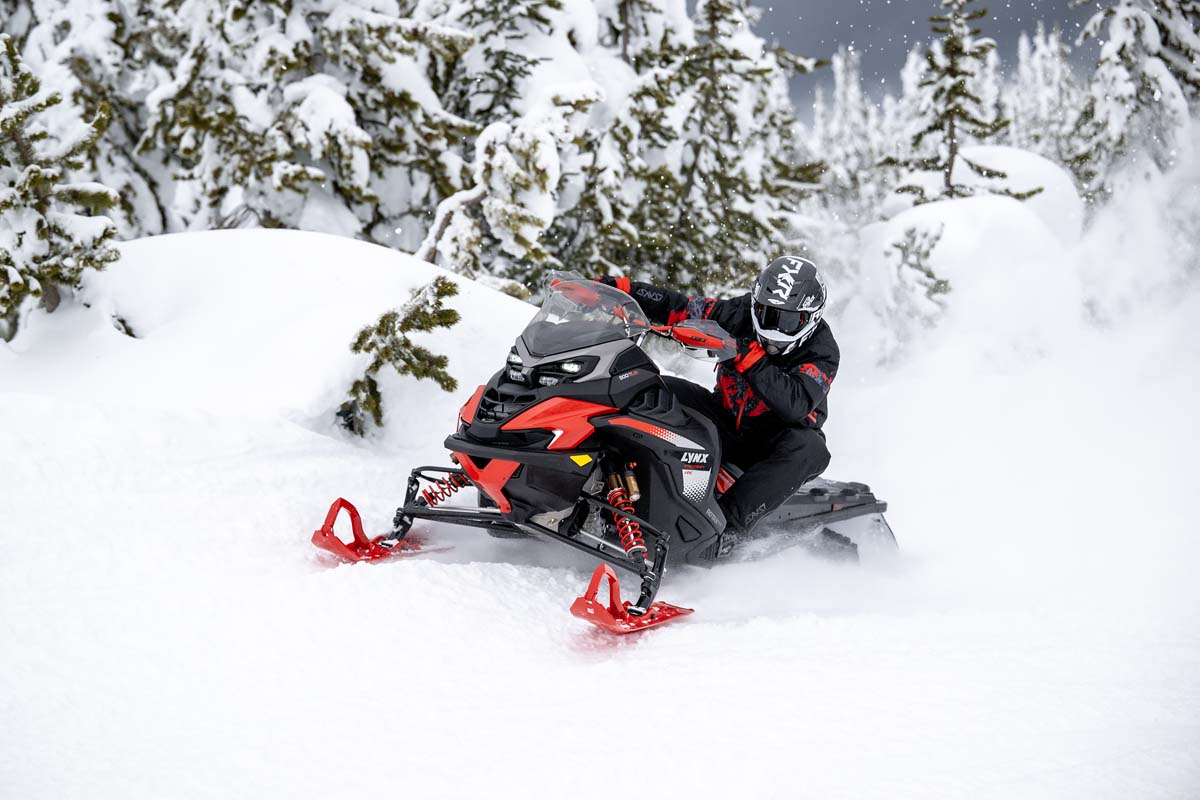
Lynx Xterrain RE 900 ACE Turbo R
Since Lynx first made landfall in North America for model year 2022, brand officials have proudly leaned into the tough-guy persona, claiming they see the market differently than any other brand – including their BRP sibling at Ski-Doo.
That attitude shows up quite strongly in the crossover segment, where the brand’s Xterrain RE models have carved out their own path while refusing to follow the pack.
The end result has been reflected in past year’s Snow Goer comparison stories whenever an Xterrain RE 850 or 850 Turbo R model has been included.
The Xterrain models have a wide ski stance like the traditional Switchback Assault, but it’s been paired with hyper aggressive skis, stiff and rugged suspensions and a general bulldog attitude that prefers riding over – not around – obstacles it may come across.
A few of the harsh edges were lightly softened before our 2025 crossover test, but the Lynx has remained far more of a bashing-and-jumping sled than one that liked to spend half its life on trails and the other half playing in powder.
Things get really wacky, however, in this 2026 comparison story because Lynx only brought one Xterrain to the Rode Reports/Snow Shoot event, and it was powered by a four-stroke 900 ACE Turbo R engine.
That meant a machine that was already heavier-feeling than its primarily competition showed up to the party with a huge engine package in the nose that creates hyper-horsepower, but does it with a truly unique powerband.
Defining the Xterrain
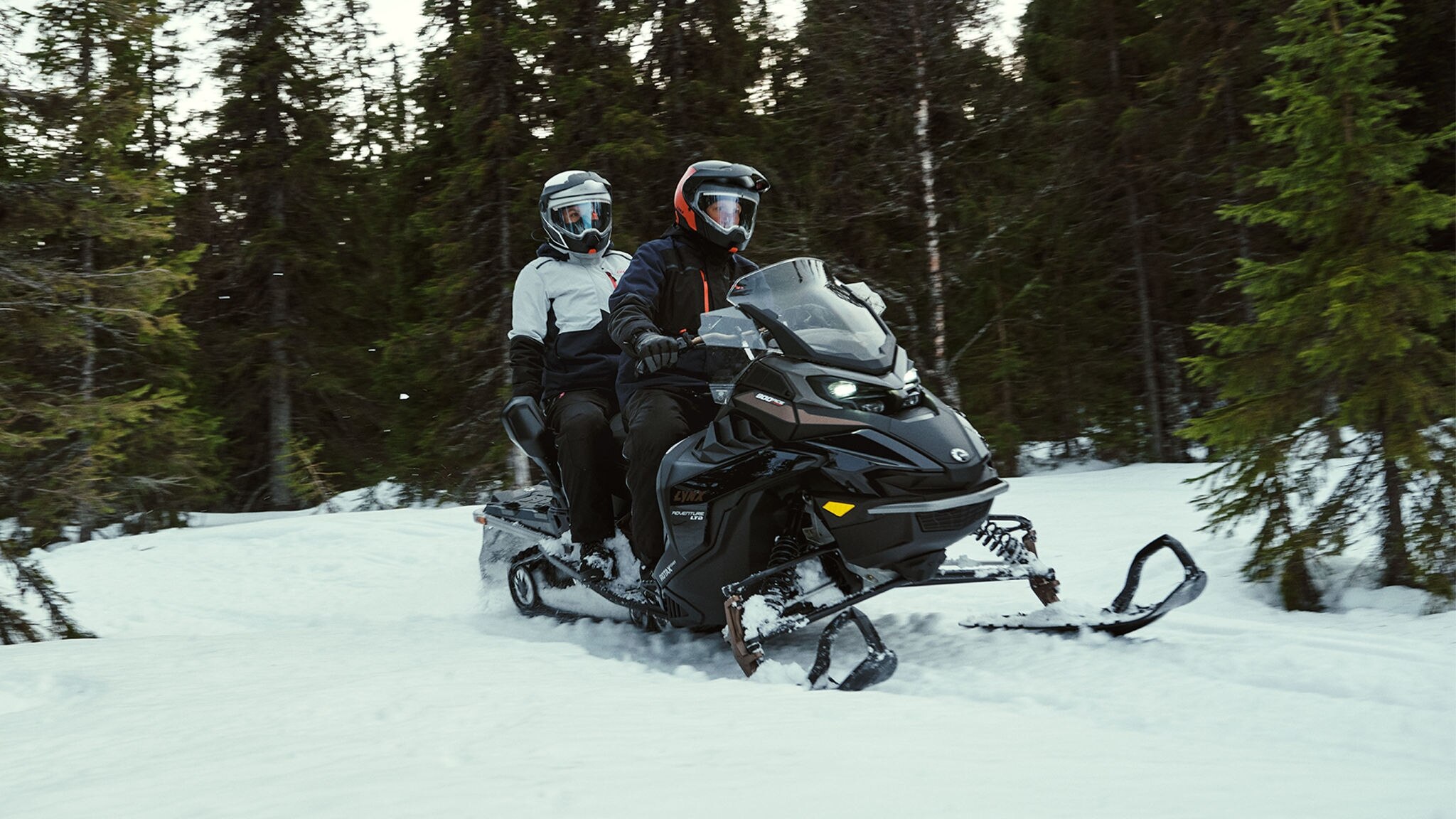
The 2026 Xterrain RE 900 E-TEC Turbo R is a striking machine to look at, with Lynx’s signature red and black coloration, a wide looking front fascia and a dazzling array of lights to show the way.
The machine rides in a wide version of the Radien2 chassis that, with its fancy clothing removed, is the same as Ski-Doo’s REV Gen5. With the body panels back in place, though, the Radien2 places the driver deeper in the chassis, with flatter running boards and subtly revised ergonomics.
Power in this unit came from fuel-injected, 180-horsepower, boosted Rotax four-stroke that’s controlled by BRP’s somewhat controversial intelligent Throttle Control (iTC) throttle-by-wire system. It feeds power through an easily adjustable pDrive primary and QRS secondary clutch, then a chaincase and onto the awaiting track.
On the four-stroke version, that track is a 15- by 146- by 1.6-inch Ice Cobra with pre-studded lugs; the oil-burning models can be had with 2-inch lugs, but not the stroker.
As always, Lynx’s most unique feature remains its beefy and uncoupled rear suspensions. The Xterrain gets the PPS3 with reinforced rails, stiff springs and oversized KYB Pro 46 Kashima-coated shocks, with clickers for exterior adjustment of high- and low-speed compression plus rebound.
Up front, the LFS+ dual A-arm suspension is more familiar looking, but it too wears the same big bore, hyper-adjustable KYB Pros and controls Blade XC+ skis.
New for 2026, the Xterrain RE comes with a four-piston caliber on its Brembo brake, an adjustable brake lever and a heated seat.
What Are Your Intentions, Young Man?
Including the Xterrain RE in our annual extreme crossover comparison always feels a bit odd because Lynx isn’t trying to make this vehicle into a groomed trail ripper or a powder-floating dancer. It has its own will.
That goes double when a high-output four-stroke turbo is stuffed in the nose. The numbers say it all: Its spec dry weight is 75 to 90 pounds more than other sleds in this test, and that’s reflected by the feel from the saddle.
Effectively rolling down the trail with the Xterrain RE takes concentration until you get used to its unique powerband. Yes, our test team is going to do it again: we’re going to rip on the iTC throttle by wire system.
“It absolutely boggles my mind that a company as buttoned-up and sure-handed as BRP continues to release performance sleds with iTC on it,” one tester said. “On tight trails, in any mode other than ECO, the throttle-input to sled-reaction rate was jumpy, lurchy and poorly timed.”
On wider trails with sweeping turns, the throttle system feels OK in Sport or Standard once you get used to it. They allow the engine to show off its ferocious power. The acceleration feel of the machine is impressive, as is its features list – from the 10.25-inch touchscreen display now with mapping and group ride to the heated seat. But when regularly on-and-off the throttle, our testers used words like “clunky” and “cumbersome” to describe its trail manners tied to the sled’s iTC system, skis, suspensions and overall weight.
Things didn’t get any better off trail, where quick and predictable stabs of power and a lightweight feel are what riders appreciate when jumping over a downed tree or picking up a single ski and carrying an edge.
“Forget the ‘knife to a gunfight’ analogy, in this case Lynx brought a sledgehammer to a ballet,” one test rider quipped.
“This is a custom snowmobile for somebody who is not me,” another rider said.
Admittedly, in the perfect world we would have had a Lynx Xterrain 850 or 850 Turbo for a more direct comparison vs. the other machines in this test. The Lynx Xterrain RE 900 ACE Turbo R that we had access to, though, just couldn’t perform as well as the others on or off the trail.