The year 1974 brought about the Sno Pro professional racing circuit that featured some advanced and some really outrageous race sleds. And nothing was more outrageous than the Alouette twin-track created and piloted by the legendary Gilles Villeneuve.
Built with experience that Villeneuve gained racing Formula Atlantic open wheel race cars, the Alouette twin-track seated the driver in an enclosed central cockpit ahead of the engine. With a very low center of gravity, it was really more like a race car than a conventional snowmobile.
“It handles better than anything else we’ve ever seen on the track,” commented John Hull, a top official of the United States Snowmobile Association (USSA), the dominant race-sanctioning body of the day.
Villeneuve got his first win with it at Peterborough, Ontario, on January 6, 1974, and that caused factory teams from Arctic Cat to Mercury to Ski-Doo to start experimenting with all kinds of radical race sled designs. But those factory sleds were not going to filter down very quickly, if at all, to the weekend warriors who accounted for the vast majority of snowmobile racers at the time.
The Manta Racer
However, there already was a sit-in, twin-track, rear-engine snowmobile out on the trails.
Bob Bracey’s Raider had been in production since 1970, with more than 10,000 of them sold. But in spring 1973, Bracey resigned as president and chief engineer of the Leisure Vehicles Inc. company that built and marketed the Raider.
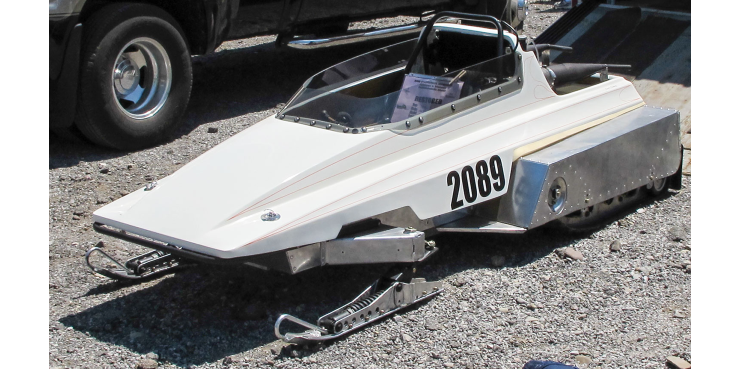
By 1974, he was back in business with ARBE (A Robert Bracey Enterprise) Products and developing the Manta “twin trac” modified racing sled. This radical machine was like a down-sized Alouette and was eligible for modified class racing in some associations, and for the USSA’s forthcoming 440X (for experimental) class.
The Manta utilized a monocoque aluminum chassis built by Texas Products Manufacturing, a company that used aerospace technology to build parts for several brands of race sleds from light weight and exotic metals including titanium.
Power was from Sachs 340 or 440 free air engines with Tillotson HR-14A diaphragm pumper carbs. However, those 60 and 74 horsepower engines (respectively) had overheating problems and were soon replaced by the Sachs 440 RX seven-port short-stroker with the far better Mikuni VM carbs that developed almost 80 horsepower. The engine and Comet clutches were unitized on a large single mount to maintain alignment. Some units were fitted with rear wings.
The original price was $2,995, but it was cut to $2,625 with the RX engine. Expensive for the day, there were no subsidies of any kind behind it either. But, unlike the Sno Pro sleds and other experimental racers from the major brands, it was available to anyone who had the cash.
Success Comes Slowly
After a prototype 440 was successfully raced on the Michigan-based MIRA circuit in early 1974, the Manta made history in November 1974 when Bud Bennett won the first-ever USSA 440X class at Brandt’s Lodge in Alaska. Bennett then ran it in the MIRA events for the 1975 season.
Dan Kirts campaigned a 1976 Manta at major national events beginning with Alexandria, Minnesota. The underpowered twin-trac was always slow off the line, but superior handling allowed it to catch the leaders if the race was long enough. Kirts absolutely stole the show from the factory Sno Pro teams at the 1976 Carling International Race of Champions at Weedsport, New York. He was the fastest qualifier for the big money feature with a newly installed Yamaha 440 liquid-cooled engine. But problems with a track adjuster caused a spin out in the Super Mod III final, costing him any chance to win anything beyond the crowd’s roaring approval.
By 1977, Connecticut racer Jean-Guy Poulin was thrilling race fans crowds in New England with another Manta twin-trac. His memorable run at the Lewiston, Maine, race saw him spin out, get back in the action, and then almost win. He had another impressive weekend at the Scarborough Downs, Maine, Sno Pro event, winning the Mod 440 class but spinning out in his 440X heat race.
Poulin put it all together the following season, winning nine events including Super Mod III at the opener at Jackman, Maine, and again at the big Paul Bunyan Championship at Bangor, Maine, to secure the USSA New England Division Super Mod III points crown in the process.
Epilogue
Only about 150 Manta racers had been sold by 1976, and Bracey was soon putting his energies into a Manta trail sled that emerged a few years later as the Trail Roamer.
Nevertheless, the revolutionary Manta twin-trac racer did pave the way for the Ski-Doo twin-tracks that dominated the ice ovals in the 1980s and into the 1990s. And that makes the Manta twin-trac a rare but very interesting and important stepping stone in snowmobile racing history.
SPECS: 1975 ARBE Manta 440
Manufacturer: ARBE Products, at Rochester, Michigan
POWERTRAIN
Engine: 431cc Sachs SA2-440-RX free-air-cooled piston-port twin with two Mikuni VM-44 slide valve carbs, buyer’s choice of magneto & breaker points or Motoplat Capacitor Discharge (CD) ignition, and twin tuned expansion chambers with no mufflers
Lubrication: Pre-mix, ratio at racer’s discretion
Power output: 76+ HP
Clutches: Comet 103C drive & Comet 90D driven
Chassis Type: Texas Products riveted aircraft aluminum monocoque tub with roll bar and fiberglass body with quick-release fasteners, no bumpers
Claimed dry weight: 325 pounds
Front suspension: Cobra aluminum skis with adjustable internal coil-spring-over-hydraulic-shock assemblies
Rear suspension: Aluminum double-bar slide rails with adjustable torsion springs
Ski stance: 37 inches
Tracks: Two 8.5-by-103-inch titanium-cleated UniRoyal triple belted with external sprocket drive
Brake: Foot-operated Kelsey-Hayes hydraulic disc
Fuel capacity: 2 gallons in buyer’s choice of plastic or aluminum tank
Standard equipment: Adjustable seat, seat belt, tether switch, foot pedal throttle and brake, butterfly steering wheel on centralized steering system, twin snow flaps, carbide runners
MSRP: $2,625