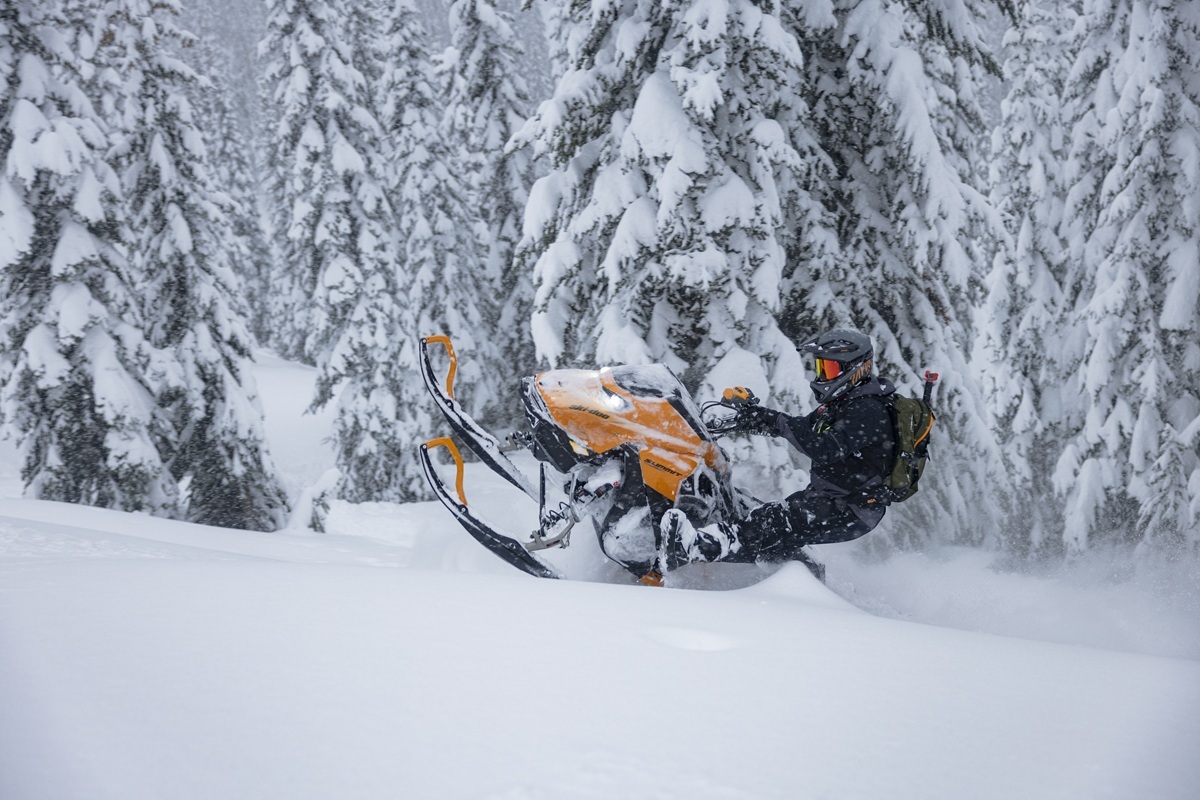
Ski-Doo has been leading the charge in recent years in creating narrower mountain sleds for chasing ultimate mobility when slicing between the trees or trying to hang onto an edge on a nasty sidehill.
In model year 2022, the brand took select Summit models down to startlingly narrow 34-inch ski stance, but critics complained that they couldn’t take full advantage because the vehicles would get hung up on the body panels when fully tilted. Ski-Doo answered in 2023 with the narrower REV Gen5 chassis platform with tighter fitting body panels, and all seemed right in the world.
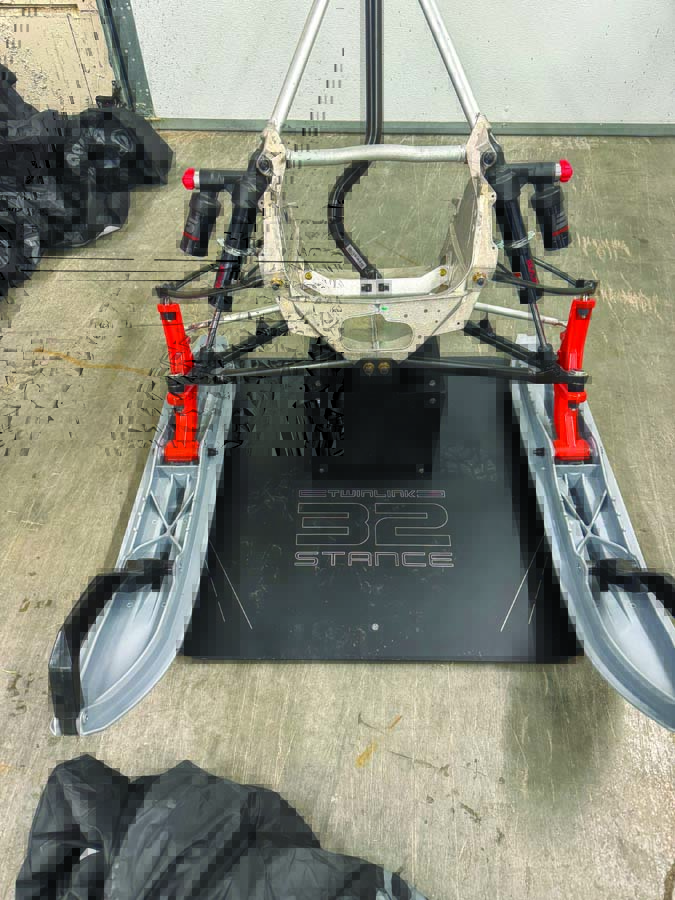
But the question remained: Could Ski-Doo designers go even narrower? For 2026, they did with a new 32-inch-wide front end – called the S32 – on Summit X with Expert Package models. What’s more, they added a revolutionary new Twin Link steering system to further enable best handling capabilities in various conditions. It is also part of a weight loss program that stripped up to 6 to 8 pounds from the machines, depending on track length.
This article originally appeared in the October 2025 issue of Snow Goer magazine. That means you could have enjoyed it long ago if you only subscribed! Go ahead and sign up today to get the print or digital edition of the magazine and feed your love of the greatest winter sport ever created.
To learn the secrets behind the narrow front end, the weight loss and particularly the Twin Link system, we turned to Maxime Dormoy, a 35-year-old project engineer who has been with Ski-Doo for 10 years.
SNOW GOER: How long has the narrow S32 front end been in development for the Summit X with Expert Package? What were the early goals?
MAXIME DORMOY: “The S32 started a long time ago, I think before COVID. It came along with the first prototypes of the REV Gen5. Having a narrower body gave us the opportunity to try a narrower ski stance without paneling out. At that time, there was enthusiasm around snowbikes, which handle much differently but are very narrow and able to play on steep hills. We thought that a narrower ski stance could improve the balance of our vehicle, and thus its sidehill capability. Precision and predictability were always important goals in our scope, too.”
SG: A consumer might think, “Shave an inch off each side – easy!” But you’ve got new spindles, new A-arms, new geometry, new shock angles. How does one thing lead to another?
MAXIME DORMOY: “In my opinion, shaving an inch on each side is super challenging. At Ski-Doo, we don’t do things halfway. We redesigned a whole new front-end package to enhance the DNA of the Expert Package – which is focused on being precise and predictable. It was time to reposition everything to reach the ultimate performance of the Gen5 platform.”
SG: What are the challenges or trade-offs of going to this narrow of a ski stance, from a design standpoint?
MAXIME DORMOY: “We’d say there are no tradeoffs if you know what you’re doing. Yes, it is more challenging to design a suspension with shorter A-arms. The kinematics (or motions) are different, and it is tight packaging – meaning, there is less space. By redesigning the lower A-arm, we were able to fit – or sink – the shock lower in the arm. Thus, we were able to keep the full suspension travel that we previously had on the Summit. Suspension travel is important for control and capacity. The suspension has to follow the ground to absorb the bumps and keep control.
“Having longer ski legs, or spindles, allowed us to fine-tune our geometry – including the camber, caster, scrub and motion ratio – and to revise the vehicle’s weight distribution.”
SG: Let’s jump into the new Twin Link steering system. How long has it been in development and what were its initial goals?
MAXIME DORMOY: “The Twin Link came around a year after the first S32 prototype. The pitman arm steering on the S32 didn’t give the feel that we were looking for. The double-pivot steering rack was good, but it is also heavy.
“Our wishes were simple. We had three goals: reduce bump steer, increase the ski turning range and add zero grams of weight. Somehow, something was burning inside me to find a new steering concept. Funny story here: the Twin Link design was born while flying on an airplane. We were coming back from a test session and I was bored by a movie. I took out a notebook and started to do steering sketches. That’s how we found the Twin Link mechanism.”
SG: When introducing it, the Ski-Doo team talked about it having the best of a pitman arm system and the best of a rack system. What is meant by that?
MAXIME DORMOY: “Very simply, the best part of a pitman arm system is its light weight. Again, the Twin Link adds zero grams to a vehicle compared to a pitman arm but it delivers more precision and more range like a rack system does.
“About precision, we mainly talk about bump steer – how straight both skis track as the suspension cycles through its travel. About the range, the skis turn an additional 6 degrees without changing the motion ratio. The steering range helps a lot for those who push the Expert Package Summit X in gnarly conditions and in tight terrain.
“As I like to explain, we drive a snowmobile with three things: the gas/brake combination, the steering and our body. Some riders drive more with the steering, some more with their body. It normally takes more time to manage the gas/brake.
“Anyway, improving the range of the steering helps a lot in specific situation. In my opinion, the benefit of having more steering range is felt when sidehilling. When on a steep slope, we have to counter steer to keep the nose of the vehicle down. The Twin Link allows the ski to counter steer more and thus, maintain control of the sled.”
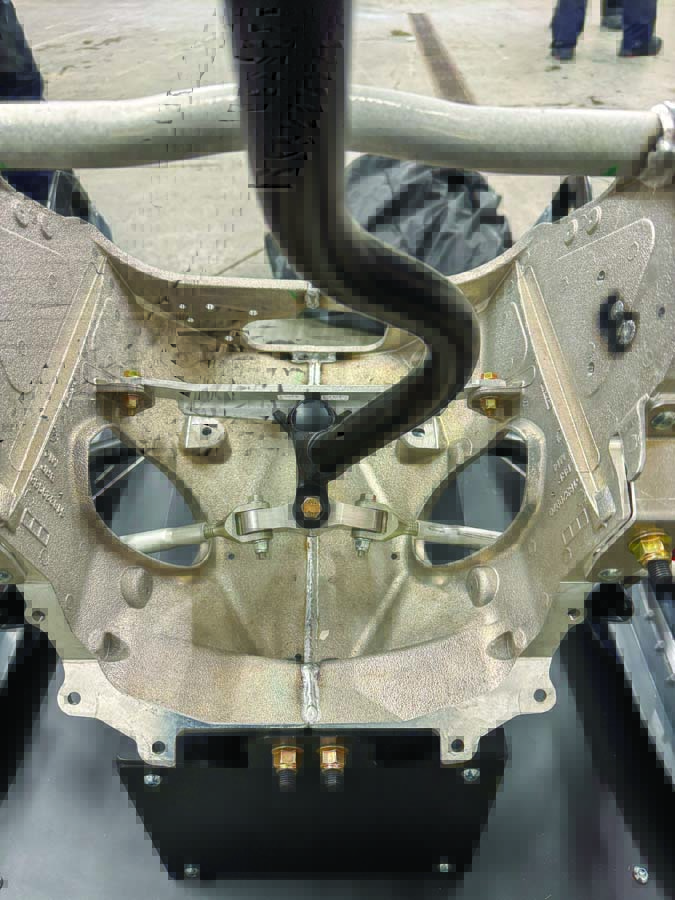
SG: Take us deeper into the nuts and bolts of exactly what’s going on with the Twin Link and why it works as it does.
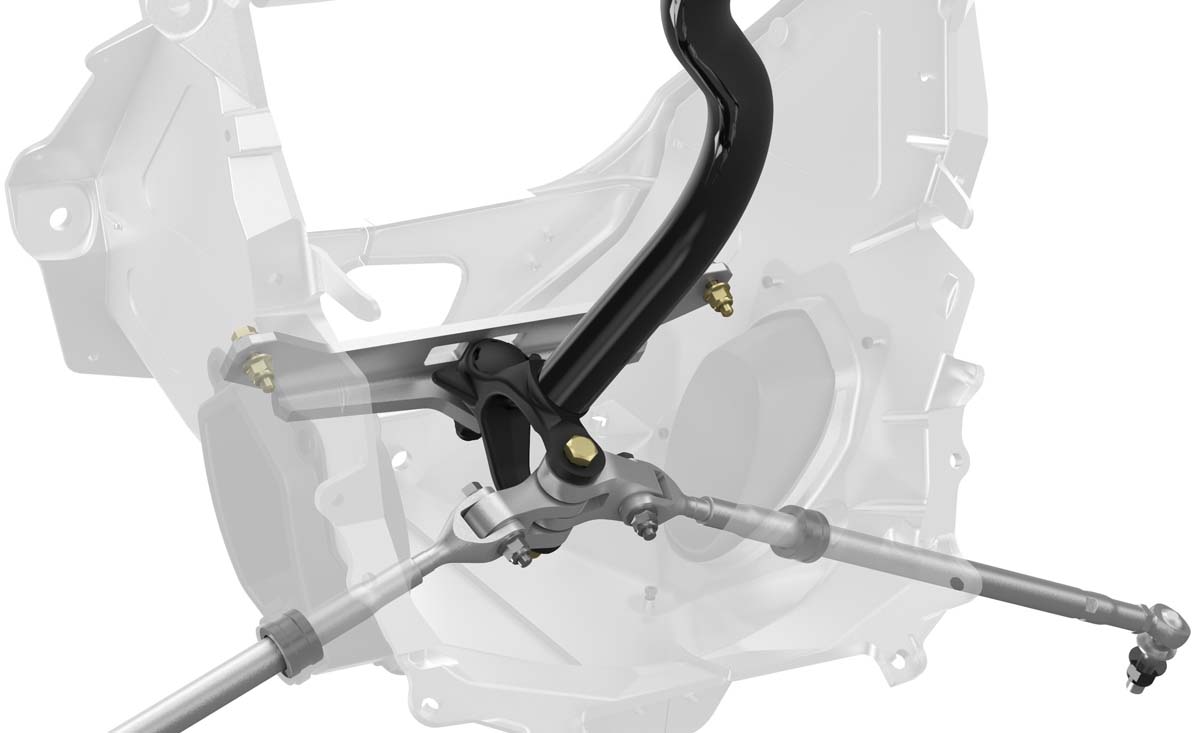
MAXIME DORMOY: “To have zero bump steer and have the skis tracking perfectly straight, there is a relationship between the A-arm length and the tie-rod length. The Twin Link is better because, from the front view, the tie rods are in two pieces [on each side]. There are aluminum links that are tied to the steering column – these are the small links that are about 100 mm long. Connected to those links are the actual tie rods. So, by effectively having a tie rod in two pieces, the actual rod of the tie rod is shorter. Having a shorter tie rod with shorter A-arms, the fit is better. And because the pivot is closer to the preferred axis, we have less bump steer. Our goal is to position that pivoting point exactly on a certain axis. So, with a steering rack system, the tie rod will be exactly on this same axis.”
SG: So then how is this Twin Link system better than a rack system? Is it just because you don’t have all of the parts of a rack system?
MAXIME DORMOY: “Yes, this is one thing. A steering rack is good, but it is so heavy.
“We also did many things to address the sloppy feel in the system. The key feature we have in the Twin Link is the [rear-facing] ball joint at the bottom of the steering column. Now, the play inside the ball joint is very minimal and it is very tight. When there is load within the system, the column cannot move and it is very tight. A second feature is that the bushings of the Twin Link are very tight. But the most important feature is the motion ratio. Because, at the end [of the handlebar travel/at full lock] with the current pitman arm, the ratio is falling. Because of that, the tie rod toggles with the steering column and the leverage of the tie rod is not as strong. With the Twin Link system, because we have only one [center] joint, the tie rod toggles less so that, with the force and the loads, there is less compliance in the system.
“With the Twin Link, even when you’re at the end of the handlebar stroke, with the position of the tie rod and the steering arm, the angle is better. It is closer to 90 degrees, so it is stronger. It’s all about the leverage.”
SG: Our test riders re-affirmed your team’s claim that – between the Twin Link and also the non-adjustable spindles – a lot of the “slop” has been taken out of the system. Why is that important for riders?
MAXIME DORMOY: “To reach more precise handling, we removed as much free play as posssible from the system and we improved the rigidity of the components. When one talks about slop in a system, there can be looseness between parts [where they connect or interact], but there is also the feeling of the parts flexing under load, which we refer to as compliance. So, now the relation between the ski and the handlebar is more ‘direct.’ In other words, the ski should not be able to easily bounce everywhere. To do this, we decreased the freeplay in the ski attachment bolt by having a wider spindle. We also added a ball joint at the end of the steering column. This ball joint, which is steel-on-steel, has very minimal play. The steering column is also less flexible and the sloppy feeling is reduced.”
SG: What are the primary advantages riders are going to feel with the S32 front end and Twin Link steering when mountain riding – whether side hilling, crossing tracks or picking their way between tightly spaced trees?
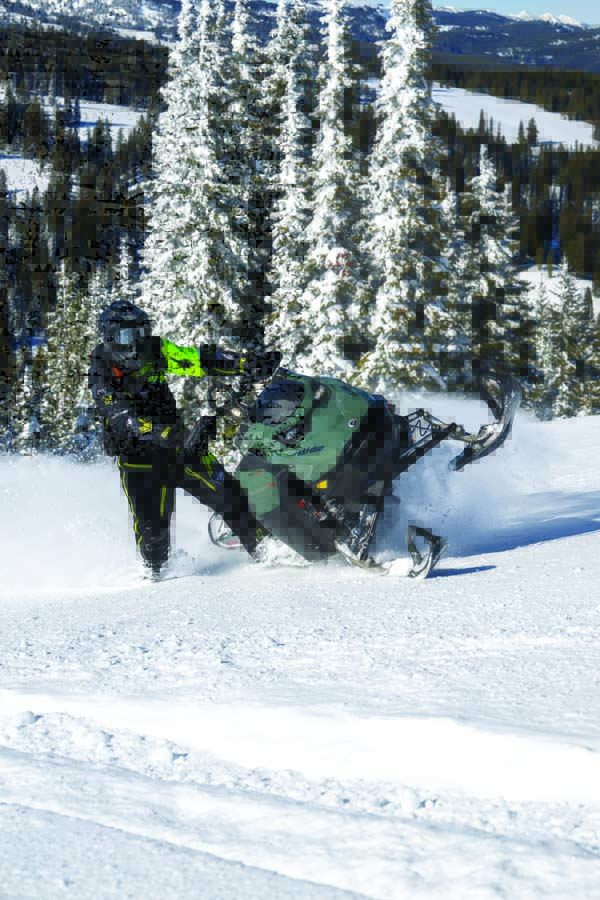
MAXIME DORMOY: “I think the first point people will notice is the stability of the vehicle. At the first glance, everyone thinks the vehicle will be tippy because of the narrow ski stance. I get it, it is completely natural to think that. But on the snow, the sled feels very stable and precise. In fact, I heard some say that the Expert Package Summit X is more stable feeling than other sleds.
“Everything is in the engineering recipe, and I think we nailed it! Now the Summit X with Expert is a sled that handles good in bumps and rough terrain while also being a strong weapon in deep snow. The narrow stance changes the balance of the sled, which gives the rider much more range and agility. I think the game is again elevated.”
SG: Previously we’ve been told this machine won’t have to be leaned as far, does that help alleviate any concerns of paneling out?
MAXIME DORMOY: “Yes, it helps for sure. There are many benefits of having a sled positioned ‘more vertical.’ The front suspension works better, the skis float more, the track has more traction – with more contact surface on the hillside – and the panels are away from the snowbank, so there is less drag. Plus, the rider is able to have a faster reaction time by staying in a stand-up position longer. It is somewhat fun jumping over the seat to the left and right running boards, but that also takes energy and time. It is more efficient to keep a motocross driving style, with one foot on each side.”
SG: In what riding conditions are folks really going to feel the advantages of the S32/Twin Link combo? How will it change their riding style?
MAXIME DORMOY: “In tight trees and steep slopes, where you don’t have many options of different ways out. Where plan B truly isn’t available. In that kind of area, the Expert will bring you where you want. To be honest, it takes time to get used to the S32. At the beginning, you may pull too hard to lean the machine and overshoot your maneuver. It’s important to take a couple of hours to re-adjust your driving style with your inputs of gas/brake, steering and body positioning. Once you are in sync with the machine, you will be confident and precise like a razor-sharp blade to conquer the most challenging terrain.”
SG: Other changes were made to the Summit X with Expert Package. Explain how you were able to use a thinner gauge aluminum in the tunnel without sacrificing strength, and use a more compact/lower volume heat exchange system without sacrificing engine cooling capabilities.
MAXIME DORMOY: “We have a strong team that works on predictive simulations. The simulations allow us to reinforce exactly where material is needed. There are no rules of thumb, it’s all calculated and lab tested. Yes, the tunnel aluminum gauge is thinner, but all the connections around the running board, the rear brackets, the bumper and the rear cap have been revised. When everything is together, it is very strong. Therefore, please don’t remove the bumper.
“For cooling, the simulations team also optimized the flow path of the coolant to be more efficient. The flow is more linear and there are fewer ‘dead spots.’ If you look carefully, the cooler/radiator shape is different. Moreover, we also changed the ice scratchers that come with the machine. In marginal conditions, the new scratchers project more snow inside the track. The snow inside the track will mostly end up on the cooler.”
SG: Now that it’s done, what about it makes you and your team most proud?
MAXIME DORMOY: “It’s our ability at Ski-Doo to ‘raise the bar’ year after year – the team works very hard to provide the best products that perform trouble free. Our vehicles continue to get more specialized and dedicated. It is nice for us, an engineers, to be able to put an idea to reality. Snowmobiling always evolves and I can tell you, it is definitely not the end. The momentum is great.”