Larson Boat Works, Inc. was founded in 1915 to construct wooden boats. Its corporate history is complex and includes non-marine products as well as brief ownership by Brunswick Corporation, which later acquired Mercury Marine.
In the mid-1960s, the Larson family re-acquired the business from Brunswick and then bought stock in Polaris in a failed attempt to acquire the Roseau sled builder. The rebuffed Larsons then decided to enter the snowmobile business with considerable help from their take-over target, and the introductory 1966 Larson line was built under contract by Polaris.
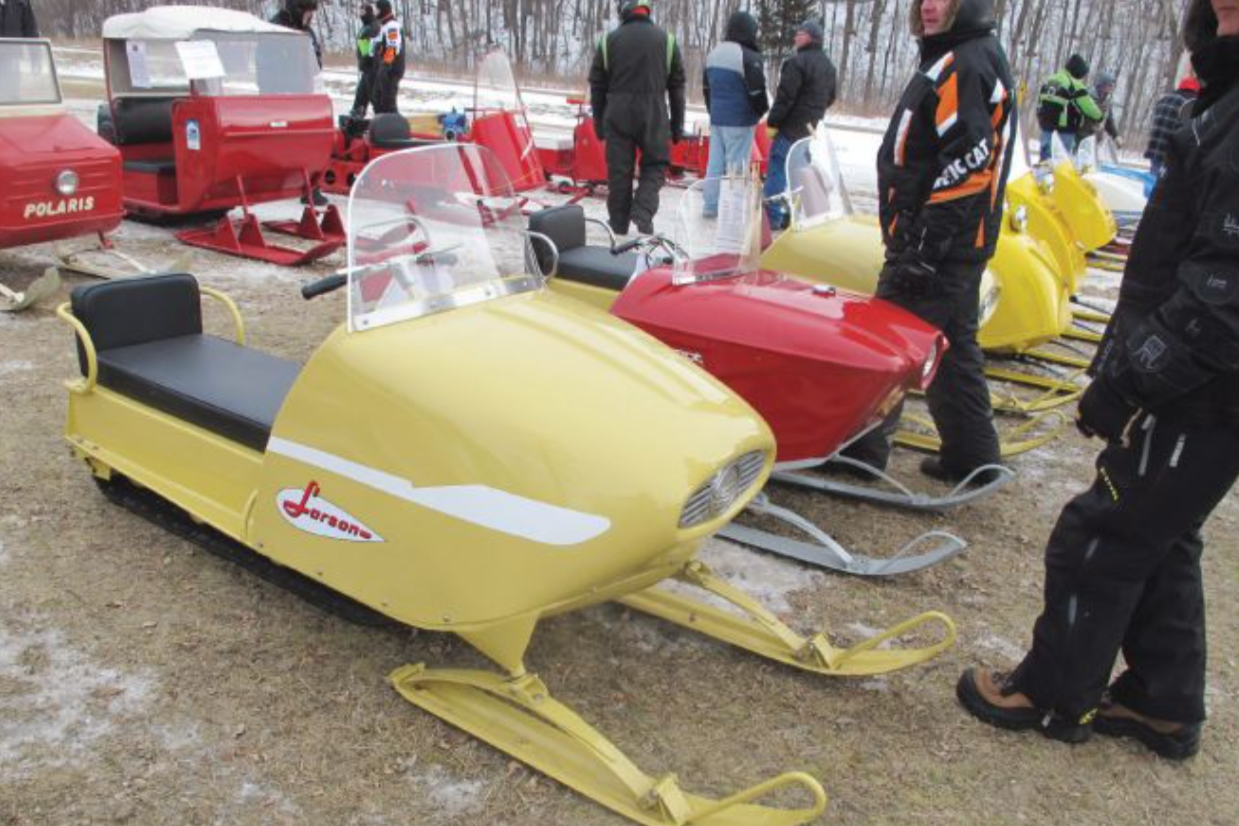
The entry-level Falcon was based on the Li’ l Andy mini-sled, while the high-end Eagle was based on the big Mustang chassis. Both featured new soft, rounded bodywork adorned in yellow. A small, twin-track ATV called a Power Hawk was also offered.
The brand’s two-year time payment plans, offered at 5% interest after 10% down, was an industry marketing innovation at the time.
Commitment To Sleds
For 1967, Larson established the Crestline Products Division to build its own snowmobiles.
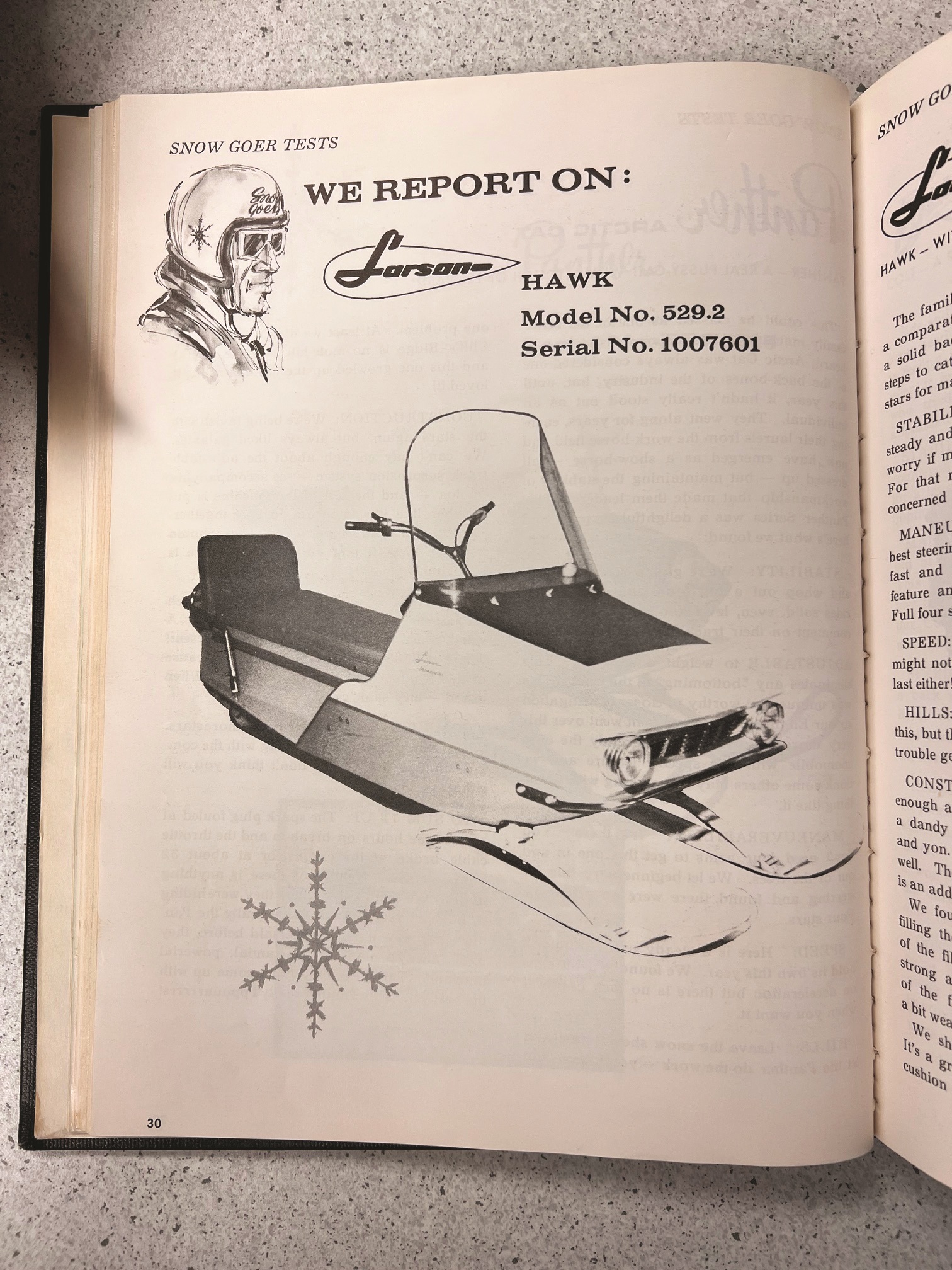
Re-designed from the ground up, the new Larson models featured distinctly automotive styling and a new white with red color scheme.
The “long, low look” with wide, nearly flat hoods and twin headlamps separated by a car-like grille was something radically new and different for the still-young snowmobile industry.
These new Larson sleds continued to use a lot of Polaris parts, but introduced yet another industry innovation. Up to this point, all snowmobiles available in North America had been powered by American or European engines. But Larson contracted with Daihatsu of Japan to supply the company with an electric start 305cc engine for the Falcon models, establishing the beginning of Japanese power in North American-built snow sleds.
Plus, a new mid-line model called the Hawk was introduced to fill the gap between the smallish Falcon and the large Eagle.
The virtually all-new 1967 Larson Hawk was the subject of one of the earliest test articles done by the recently established Snow Goer magazine. Our editors at the time were generally very impressed with the Hawk, beginning with the automotive-inspired styling that got their top rating of five stars. “It is ahead of the rest,” the review stated, calling it a “real head turner.” Our testers were also impressed with the “nice, steady and level ride,” and rated the new Hawk as having “one of the best steering and handling responses” available. Speed and hill climbing were judged very adequate.
Reviewers also liked the snap-on and -off seat cushions, the tip-down windshield for trailering and the under-seat storage compartment.
Unfortunately the gas tank leaked, and the gas filler behind the windshield made refueling difficult. Then the head gasket on the engine blew after about 20 hours of
testing, but that was a problem caused by engine maker JLO, not Larson.
“You couldn’t go far wrong in choosing this for a family vehicle” was the final summary from our predecessors, with acknowledgement that Larson was taking steps to deal with the gas tank issues.
Some Help, But Not Enough
However, production difficulties led to slow deliveries of all Larson models.
The model year 1967 Larson sled sales never met expectations, despite signing up two of the company’s most important boat customers for private brand editions of the sleds.
The McLeod’s Company was a general merchandise chain store in Western Canada that took on a thinly disguised version of the’ 67 Larson re-christened as the Hiawatha Power Toboggan. The Marshall-Wells Hardware Company of Duluth, Minnesota, operated stores on both sides of the border and did likewise, calling their even more thinly disguised version the Black Hawk.
Sales were also poor for these clones, and both stayed on the market basically unchanged for the 1968 season to reduce inventory.
The automotive look was one-anddone for Larson. All later Larsons were simply re-badged Polaris sleds constructed at the Polaris plant in Beausejour, Manitoba. These Polaris clones were also sold by McLeod’s, Marshall-Wells, Sears and Eaton’s of Canada, the last as the Eaton Viking, which is not to be confused with the very different American-built Viking snowmobile.
Early End
The end of the Larson snowmobile came quickly. A liquidation of inventory in 1969 signaled the last year for the brand.
Even with what was probably a better-than-average product for the day, plus allies like McLeod’s and Marshall-Wells stores, Larson production and distribution just weren’t getting the job done. So despite innovations in marketing, styling and power, Larson could not justify remaining in the over-heating snowmobile market of the day.
And now any of these models are rarely seen, particularly outside the Midwest.