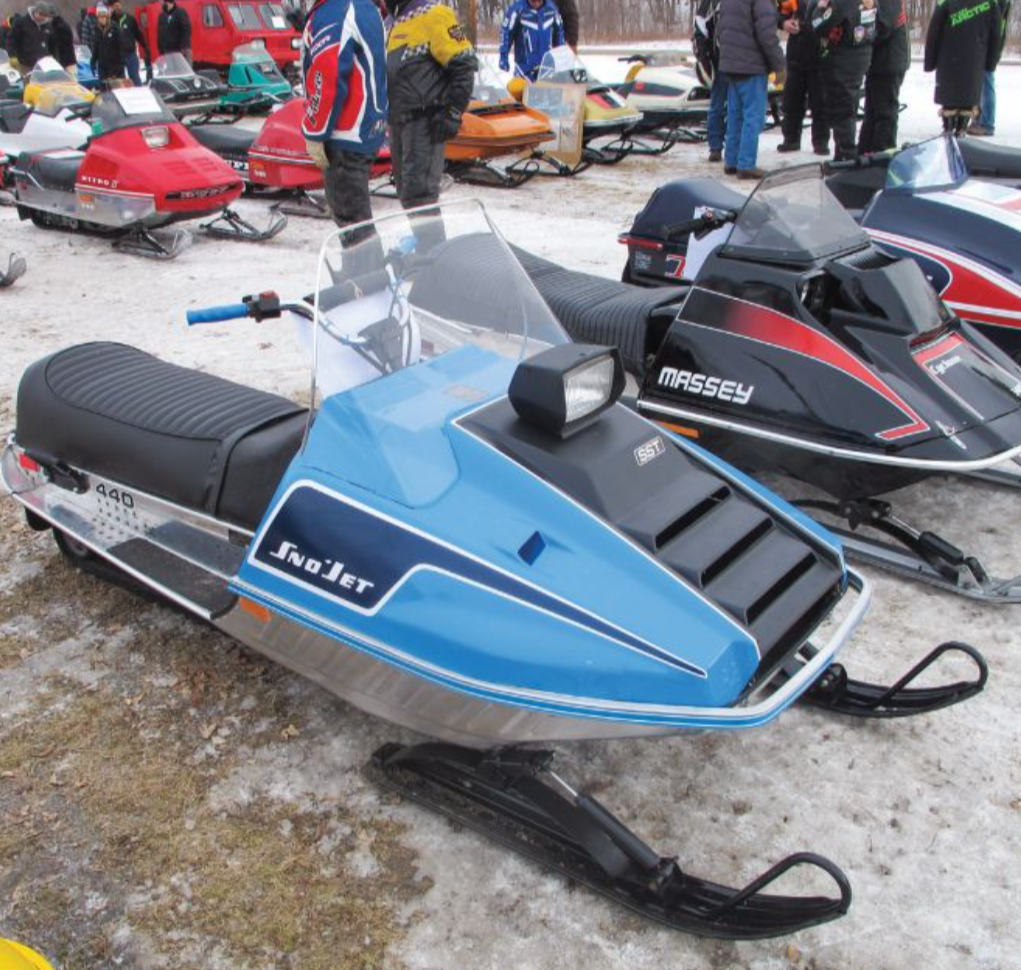
1976 Sno Jet SST 440—The End Of The Trail For Big Blue
SnoJet was one of the highest flyers of the vintage snowmobile industry. From a modest beginning in 1965, the Thetford Mines, Quebec-based brand grew rapidly to be a top five manufacturer at its peak in model year 1970.
Along the way, it was purchased by the Conroy Corporation of Texas. That acquisition infused advanced engineering and materials technology into the company’s ThunderJet race sleds and made the brand winners on oval tracks.
But the Big Blue brand that had started as yet another classic Ski-Doo clone was very slow to adapt its industry-leading racing technology to its trail sleds. Consequently SnoJet sales slid dramatically while the industry struggled with excessive production and then crashed due to the 1973 oil shortage. Losing a 1974 legal battle with the United States Snowmobile Association (USSA) over what would be allowed as Stock class race sleds was another big blow to Big Blue.
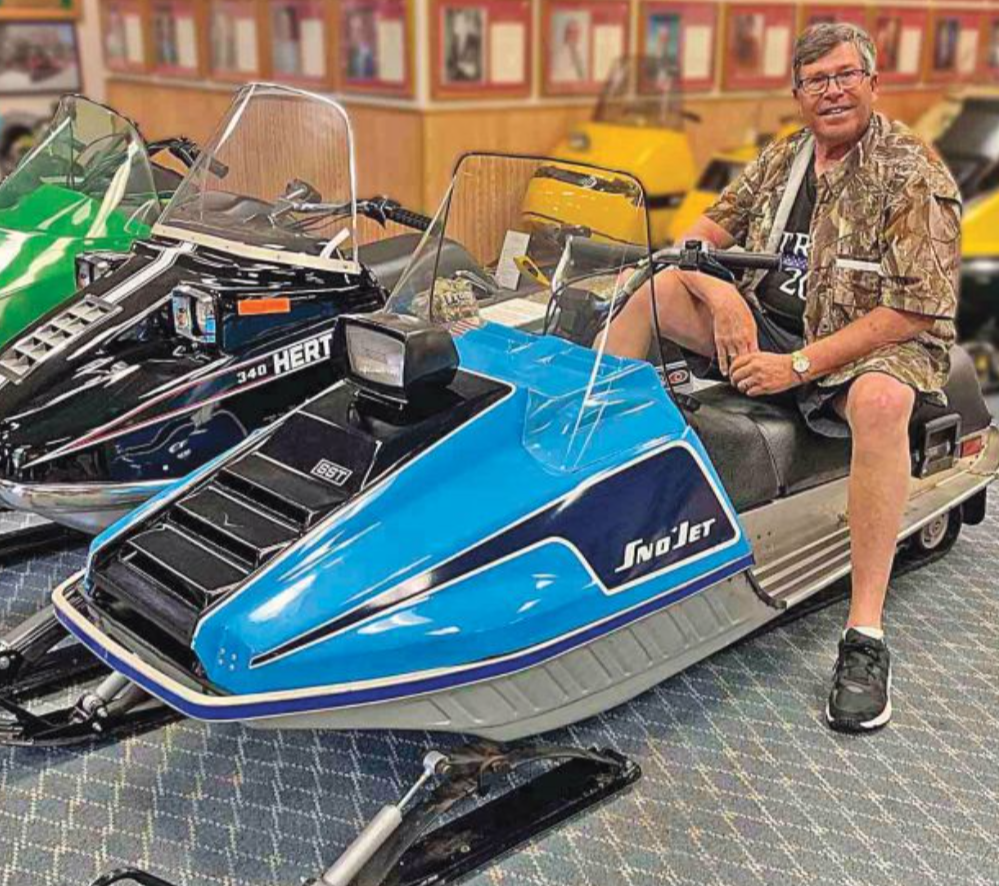
Nevertheless, SnoJet managed to pull things together with a virtually all-new 1975 SST, its mainstream sports trail model. Engineered over a two-year period with approximately $600,000 in design and tooling costs, the new machine incorporated the latest ideas and broke new ground with a tapered tunnel that performed better in deep snow than older designs.
Reportedly, the new SST was intended to accommodate any type of cooling system – fan, free air or liquid. Multiple magazine testers found the new ’75 SST very impressive, creating a ray of hope for Big Blue.
Best Jet Yet
The key 1976 SST prototype that Snow Goer tested in Spring 1975 was a 1975 SST FC powered by the new Yamaha E-series axial fan engine. Fitted with a Mikuni VM carb instead of the previous Keihin, the E-series engine received new pistons and revised porting, plus a new, lighter, one-piece exhaust system. SnoJet claimed a 20 percent boost in horsepower with all of these changes.
Snow Goer editors at the time reported that the latest SST ran well but was outpaced by about a half-dozen other machines in the shrinking fan-cooled performance class. They commented that chassis dynamometer testing showed that this ’76 prototype did not get horsepower to the track as well as the 1975 model.
However, the light weight and tapered tunnel gave the SnoJet a real advantage in deep snow.
“We only found one other sled that could handle the powder in the same way as the two SSTs – fan and FA – and that sled was a distant second,” our testers advised readers.
Our test pilots were also very complimentary on the ride quality.
“Comfortability on the SST over actual trail riding conditions would easily rank in the top three of any mixture of family trail-riding sleds,” our scribes reported confidently.
Snow Sports magazine praised the SST’s superior hill-climbing ability and concurred about the excellent ride quality, saying, “Unlike heavier sleds, the SST enables the driver to steer around many of the biggest bumps.” They said, “The sled exhibits a good balance of performance, trail characteristics and responsiveness,” but also expressed concern that light weight sleds sometimes tend to shed pounds at the expense of durability and hoped that would not be the case with the SST.
Our Snow Goer editors concluded, “The SST fan is no longer the king of the lakes, but it’s still the crown prince of the trail.”
Jet Crash
Big Blue had been hemorrhaging money from steadily declining sales and market share for several seasons, and Conroy wanted out.
In March of 1975, a soft economy in Quebec helped force layoffs of 450 workers at SnoJet’s Thetford Mines factory. Work resumed within a month, but rumors of a sale of the business had started circulating. And sure enough, in early November of 1975, Conroy announced that SnoJet had been sold to Kawasaki Motors Corp U.S.A.
Unsaid was that Kawasaki really wanted the brand’s dealer network, not its engineering or manufacturing capability, so the sale did not include SnoJet’s Thetford Mines factory or the brand’s U.S. headquarters, which included an R&D center and warehouse in the Burlington, Vermont, suburb of Winooski.
Soon Arctic Enterprises was starting production of the 1976 SnoJets under contract from Kawasaki. Although free air 340 and 440 SSTs were announced, none were built, leaving the 440 fan as the sole 1976 SST variant actually produced. Only about 4,200 SnoJets of just three total models (Astro SS 340 and Astro Jet 295 were the others) were built for model year 1976, a far cry from the 31,000-plus Big Blue sleds built for the 1970 season.
The 1977 Kawasaki SnoJet SST fan cooled sled was a low-volume interim product. Starting with the same sled, it had 60 detail changes that improved the machine in many ways for its last hurrah. Kawasaki introduced machines of its own design for 1978, and with that move SnoJet became yet another snowmobile memory. And the 1976 SST 440 fan SST remains the last and arguably the best real Sno*Jet trail sled ever.