Clutching 101: Understanding the Basics of a CVT System
For some high-performance riders, modifiers and racers in the snowmobile world, clutch tuning is a fascinating fine art. They talk about clutch weight combinations, helix profiles and spring rates with deep reverence – but usually only in broad terms. Ask those same people for their exact preferred combination of those parts, and suddenly they get guarded – as if protecting top government secrets or Area 51 details.
For many other snowmobilers, though, the whole clutching system and its mysteries are nebulous and distant. They aren’t particularly interested in what’s happening mechanically every time they press the fun flipper toward the handlebar. Instead, they just want to ride, rack up miles and make lasting memories.
Luckily for the latter group, today’s snowmobiles come from the factory far better dialed-in than they used to. So, the need to buy so-called aftermarket clutch kits or concoct your own setup to attain decent performance isn’t nearly as critical as it was 25 years ago.
Still, understanding the basics of how a clutch system works is valuable for any snowmobiling enthusiast. It can help you diagnose problems – or at least explain them more clearly to the service manager when your sled starts acting up.
The Parts
Let’s start with the basics. A clutching system in a snowmobile contains two major components.
First is the primary clutch – which is often called the “drive” clutch or pulley. It is mounted to the end of the crankshaft that comes out of the engine.
It connected via a drive belt to the secondary clutch – also known as the “driven” clutch or pulley – which is mounted on the jackshaft.
Working together, the clutches and belt are the sled’s transmission – in this case, what’s known as the continuously variable transmission (CVT). Unlike most cars, motorcycles or even bicycles that have fixed gears, the CVT constantly adjusts its ratio based on input both from the engine and the driveline.
When the engine is not running, the primary clutch will be open wide and will have the drive belt resting at its bottom. The secondary clutch will have the belt pinched at its very top.
How It Works
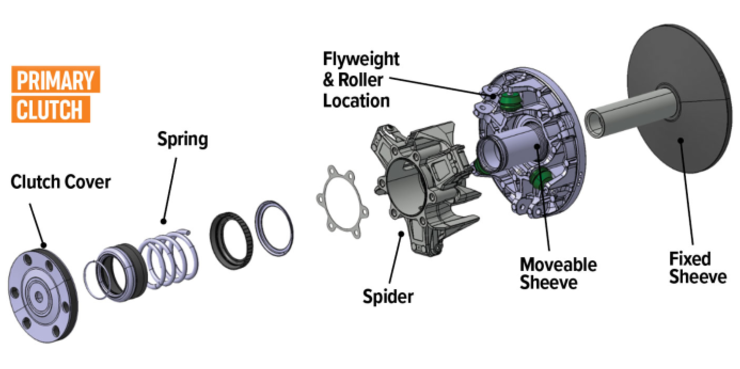
Clutch designs vary by brand and era, but in general terms a primary clutch includes the following major parts:
- Two large sheeves or faces – one in a fixed position and the other one is moveable on a shaft
- A cover on the outer edge of the moveable sheeve
- A specially calibrated spring that is between the cover
- The spider, which features rollers and carefully shaped and weighted arms. They are the flyweights.
There are also washers, bushings and other assembly parts that keep everything aligned, but the parts listed above are the heart of the primary clutch.
Here’s how the parts interact: When the engine is started and is idling, the primarily clutch starts spinning but the tension from the clutch spring holds it open and keeps the two sheeves apart.
As you squeeze the throttle, engine RPM increases and so does the speed of the spinning clutch. Within the clutch, centrifugal force pushes the flyweights outward against the rollers. This converts the circular motion into lateral force, and that force starts overpowering the spring force.
At some point (clutch engagement) the moveable sheeve moves far enough to pinch the drive belt against the fixed sheeve and start spinning the belt itself. As engine speeds increase, the belt squeeze increases, causing the belt speed to increase as it rides higher in the primary clutch.
Secondary Clutch Basics
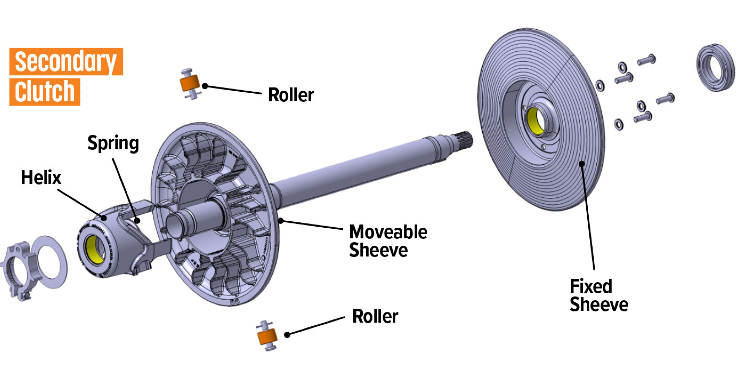
The secondary clutch contains its own sheeves – one fix, one moveable – plus its own spring. It also has an oddly shaped item called a helix, which has specially calibrated ramp-like surfaces for buttons or rollers to ride against.
At rest, the drive belt rides in the very top of the “closed” secondary clutch. Its sheeves are being held together by the secondary clutch spring.
Once the belt is being driven by the primary clutch, the pull overcomes the force of the secondary spring and the secondary clutch starts to open. That’s when the sled starts moving.
As engine RPMs increase, the spinning belt moves higher in the primary clutch and lower in the secondary clutch, generating its gear ratio. An engine running at its preferred peak RPM would have the CVT in the equivalent of its highest gear, with the belt in the top of the primarily clutch and bottom of the secondary clutch.
Outside Factors
If we lived in a friction-free and flat world, that’s all you’d need to know about clutches. But snowmobiling is full of deep powder, steep climbs and ever-changing conditions – that’s what makes it so much fun! Consequently, there’s another important layer to the CVT’s function – and its magic.
Just as a car automatic transmission downshifts to a lower gear when going up a steep hill, a snowmobile CVT needs to downshift (or “backshift”) when the track encounters extra resistance to generate maximum performance. This is also important in cornering and braking and then re-accelerating.
Torque feedback coming back up from the track and drive line acts upon the secondary clutch’s rollers or buttons and they act against the helix. That in turn forces the secondary clutch to start closing – squeezing the belt and sending resistance back through the belt to the primary clutch. The primary will start opening back up, in effect lowering the CVTs gear ratio and shifting the driveline into a lower gear to maintain momentum without bogging down.
That’s essentially the push and pull of the CVT system. It’s constantly getting feedback from the engine power through RPM while at the same time getting feedback through the driveline based upon what the snowmobile encounters.
The Real Magic
Every snowmobile engine has a “sweet spot” – it’s power band where it produces maximum horsepower. For this example, let’s say that’s 8000 RPM. That would be the preferred peak RPM.
The clutch system’s job – and, in essence, of the clutch tuners art! – is to get the engine to 8000 RPM smoothly and efficiently without going over or under it, and get back to that RPM efficiently when forces act upon the driveline to drive the RPM down.
That’s achieved through a careful combination of the previously mentioned components, including the springs, flyweights, helixes, rollers and the drive belt itself.
Engine modifications that alter the preferred peak RPM, changes in riding conditions (particularly changing altitudes) and wear-and-tear on components can all create situations where a clutch tuner may alter those tunable parts.
Even on “stock” snowmobiles, springs can weaken or even break, rollers can bind, belts can narrow, etc. Many snowmobiler may notice when their sled feels lethargic or isn’t performing as expected; an alert snowmobiler will notice that their gauge is telling them if their engine is falling short of its powerband or over-revving.
Entire books have been written devoted to clutch tuning – most famously by the late Olav Aaen who is remembered on page 46 of this issue. A great clutch tuner can create magic and is invaluable to race teams. But we’ll save that story for another day.